

Could we see the Northern Lights in the DMV?
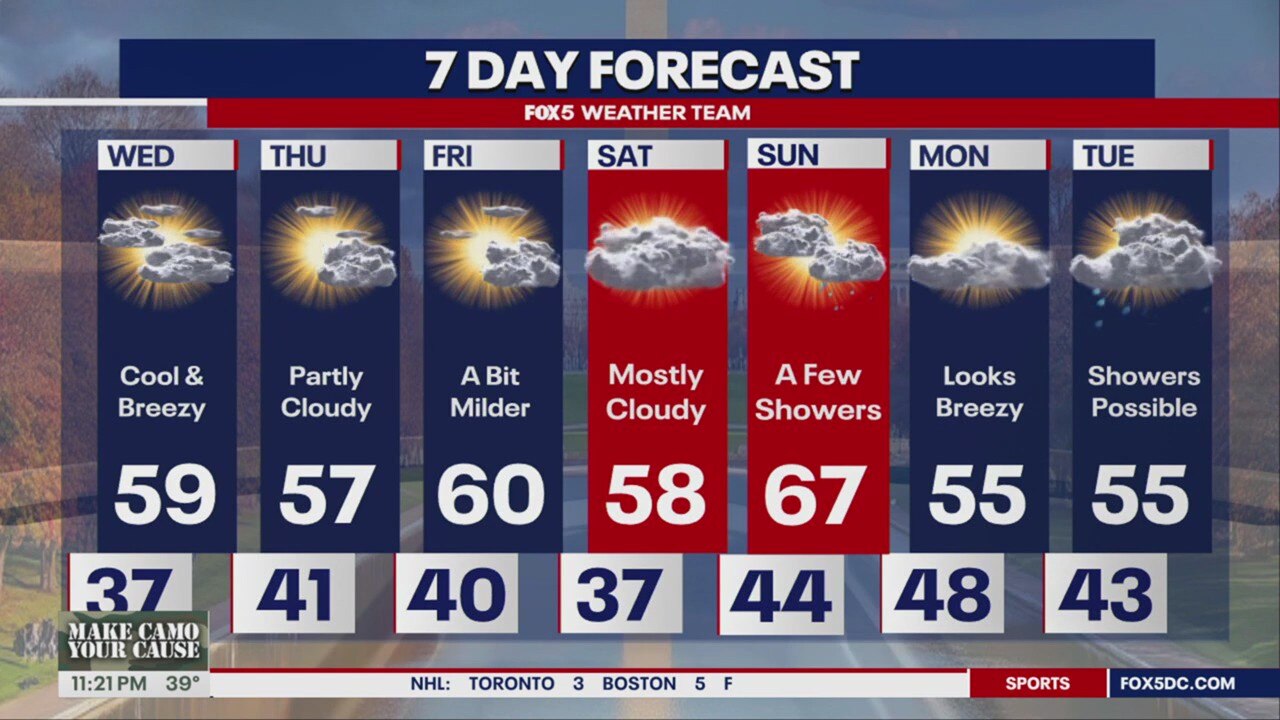
Chilly week ahead with more winter-like temperatures
Temperatures will remain fairly low this week, with big drops at night, bringing a winter-like feel to the DMV. FOX 5's Mike Thomas has your latest forecast.
WASHINGTON - Do DMV residents have a shot at viewing the Aurora this week?
Here's what we know.
Northern lights visible in parts of US
Solar flares:
We are under a G4 Severe Solar Storm Watch with a Coronal Mass Ejection (CME) expected to impact Earth's magnetosphere over the next 24+ hours, FOX 5 meteorologist Mike Thomas says.
Over the last 24 hours, the sun has emitted several powerful solar flares, including one X-class flare (the most powerful category of solar flares), two M-class flares (moderate) and 25 common solar flares.
With compounding coronal mass ejections making their way towards Earth, it is very possible for people living in the northern part of the United States to see some stellar auroras Nov. 11, Nov. 12 and Nov. 13, according to the NOAA’s Space Weather Prediction Center.
The latest projections from the University of Alaska projects a Kp index of 6-7 between 10 p.m. Tuesday and 4 a.m. Wednesday, with the Aurora possibly visible in the northern sky — though you'll likely need good camera equipment. Additionally, in the D.C. area, you'll also be up against some cloud cover locally.
NOAA predicts peak Kp values around 8, but this would be during daylight tomorrow morning (~10am) unfortunately. But Kp could stay high enough that some horizonal viewing is possible (Kp forecast around 6)
For comparison, the solar storm that let us see the Aurora overhead in DC back in May 2024 was a Kp 9.
The best times to see northern lights in the US
Dig deeper:
The NOAA said the best times to potentially see northern lights from the U.S. are:
- 4 p.m. to 10 p.m. ET
- 10 p.m. - 1 a.m. ET
A geomagnetic storm watch was issued by the NOAA on Tuesday, with predicted storm categories reaching strong and severe.
- Nov 12: G4 (severe) category storm
- Nov. 13: G3 (strong) category storm
- Nov. 14: G1 (minor) category storm
Tips on seeing northern lights:
- Try to find an unobscured view and look toward the northern horizon.
- It must be dark outside, so if you can, go somewhere that has as little light pollution as possible.
- The best time to see auroras is within an hour or two of midnight, according to the NOAA.
- Check the weather forecast because clouds can cover up the spectacle entirely.
- Taking a picture with a smartphone camera may also reveal hints of the aurora that aren’t visible to the naked eye.