

Snow storm threat: What to know about the winter weather expected in the DMV this week

DC weather: Snow, arctic air blast threaten region this weekend
Heavy snow and a cold blast of arctic air threaten the Washington, D.C. region this weekend.
WASHINGTON - You have without a doubt heard the buzz by now, and the rumors are indeed true.
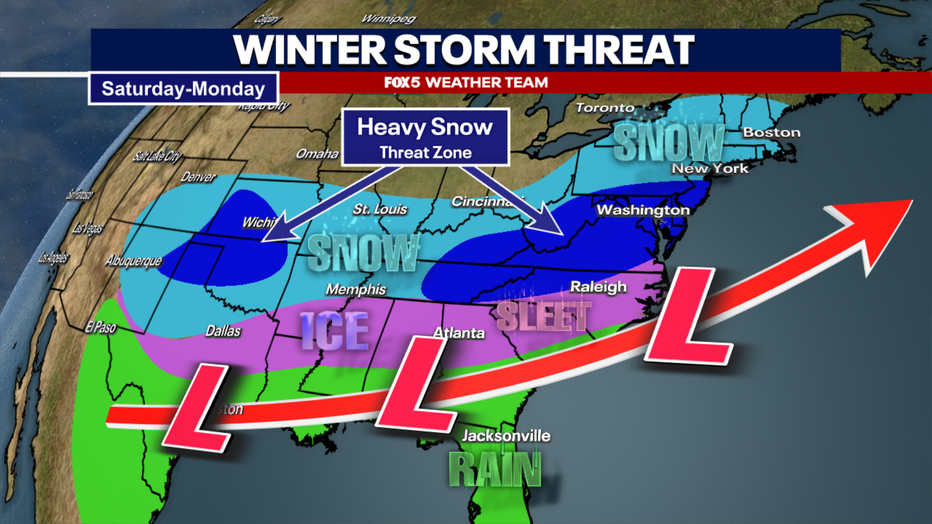
Washington, D.C. and much of the Mid-Atlantic region have the potential for one of the more impactful snowstorms in recent memory to impact our region this upcoming weekend, Jan. 24-25.
The setup:
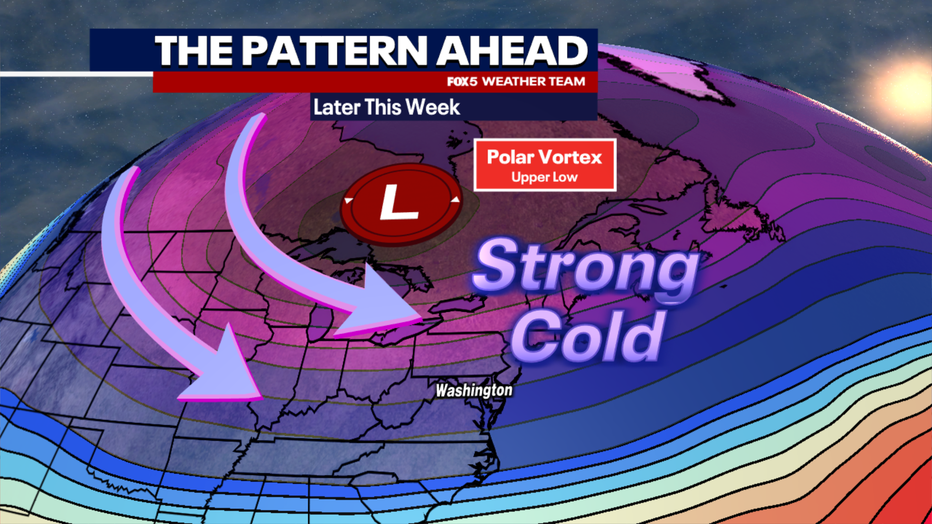
After a quiet middle of the week, the stage for the storm really begins to be set on Friday as a strong upper low coming from the North Pole — a true polar vortex — dives southward across eastern Canada.
RELATED: What is the polar vortex? Why it matters as snow and Arctic cold threaten the Northeast
This will bring down some of the coldest air of the season so far, in a season that has already been quite cold. Temperatures likely struggle to make it above freezing Friday afternoon and quickly dive through the 20s and into the teens after sunset on Friday night.
Most of the region woke up to temperatures in the teens on Saturday morning, with some to the far west of town perhaps even pushing single digits. This will cool the already cold ground temperatures significantly ahead of potential snowfall, with most expected to stay in the teens and 20s all day on Saturday.
READ MORE: Polar vortex, snow models used to track impact of possible weekend storm in DC
The timing:
One thing to make perfectly clear is that this storm is still in the "mid-range." That is four to five days in the future.
In recent history, there have been several major winter storms that have looked great in the weather model world at this range, that have then gone on to disappoint snow lovers at the progressed into the "short-range" of the one-to-two-day period, including a notable case from February of last year.
We are still very much in the range where major shifts and changes are possible.
What has so far separated this event from those has been multiple weather model consistency and agreement, something that is often seen in larger scale winter storms.
Weather models typically are able to get a better handle on the larger atmospheric patterns that play a role in their formation faster than other winter scenarios. Such was the case with the Blizzard of January 2016.
So, the fact that, as of this writing, just about every major weather model out there is showing a significant snowfall for the D.C. region does up the confidence at this range.
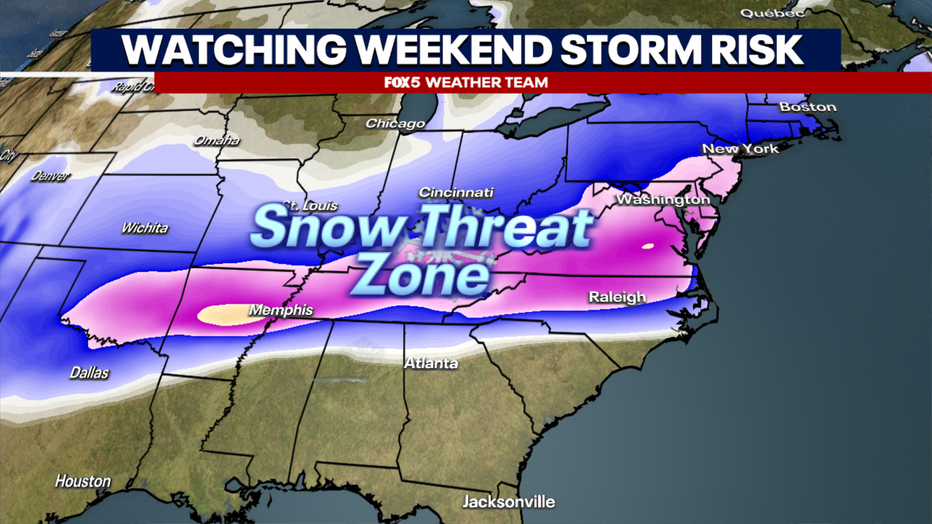
Most models agree that the bulk of Saturday is dry: Clouds build throughout the course of the day, ahead of the first flakes moving into the region after sunset. Southwest areas will get hit first, as the system will be progressing from the southwest to the northeast. One thing to note is that it may take well into the late evening hours of Saturday, if not into the overnight hours, for the snow to start to fall.
Arctic air will move in Saturday afternoon, and Arctic air is very dry. It will take a while for the snow to actually reach the ground without evaporating. It is entirely possible that many in the region do not see any significant snow impacts on Saturday at all as this process takes place.
Sunday is the big day. As mid-level winds turn out of the southwest ahead of a trough of low-pressure diving through the Plains, more moisture will be forced up and over the very cold air that will be entrenched across the D.C. region.
Heavy snow is expected to start well before sunrise and could continue through much of the afternoon, before lighter but steady snows continue through the evening hours, scattering out overnight into Monday morning.
Assuming no major changes in the days ahead, travel may be downright dangerous to impossible on Sunday across the D.C. region. Plan to hunker down at home and avoid traveling through the day on Sunday.
Featured

DC, Maryland, Virginia winter weather checklist: How to prepare for snow and ice this weekend
As snow and bitter cold threaten the Washington, D.C. region and Northern Virginia this weekend, this local checklist outlines key preparations for your home, travel and daily routines.
The amounts:
Of course, what everyone really wants to know is: How much are we getting?
While I believe it is safest to wait until at least three days before the system due to possible changes in the track before we start issuing our official potential snowfall forecast from FOX 5, model guidance with the storm so far has generally been on the higher side.
You often here weather forecasters talk about the American and European weather models, the two most famous ones, though there are many more. But for the sake of simplification, we will focus on those two here.
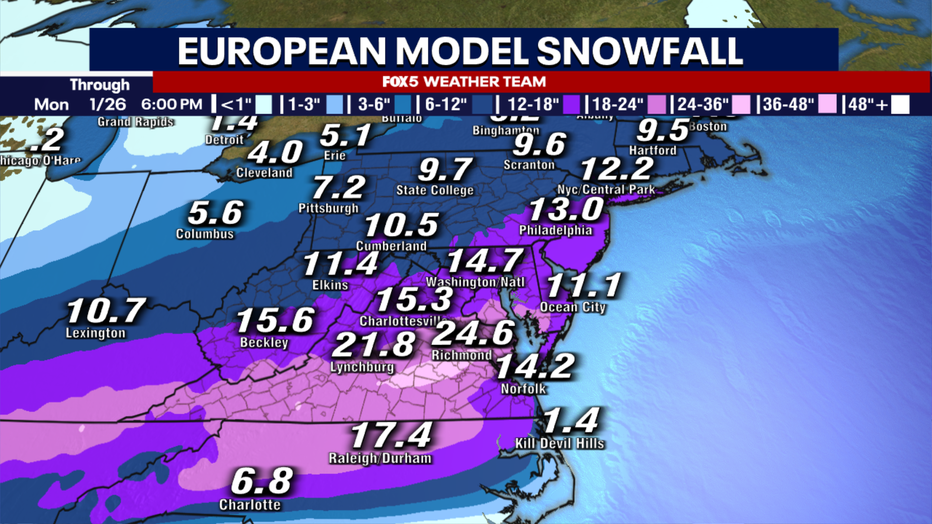
The European is typically considered to be the stronger performer and more accurate of the two weather models. The model has consistently been showing over the last couple of days a potential for over a foot of snow in the DC area. It has kept the heaviest amounts, totaling closer to two feet, closer to central Virginia, with lesser amounts (but still a solid snowfall) northwest of town. Recent runs have suggested a widespread 10-16" or more possible across the region.
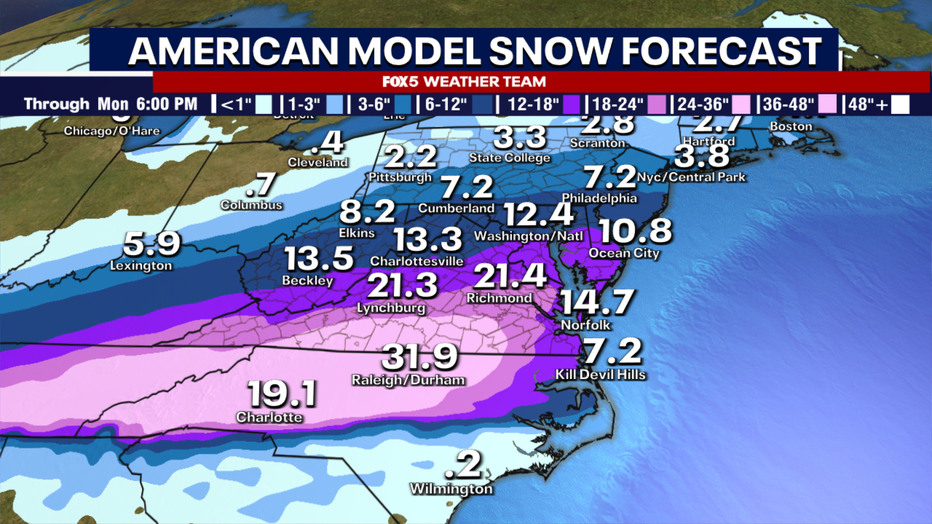
By contrast, the American Weather Model has so far been much more inconsistent as it struggles with the exact strength and track of the wave of low pressure as it crosses the Southeast United States.
While the most recent run that was released on Tuesday night did show better agreement with the European model, showing a widespread 8-12" or more in the region, it has at times shown considerably less. Its subsequent run from this afternoon only showed a little over an inch of snow in the D.C. area.
What we as forecasters want to see is several runs of both forecast models come into at least closer and more consistent agreement before issuing our official outlooks.
Note that as of Tuesday night, both these two major weather models as well as a number of other models not shown here, do suggest an impactful snowstorm will hit the D.C. region this weekend.
What can change?:
It is the word no forecaster ever wants to say: Bust.
A busted forecast is the term given to a forecast for a significant weather event that ends up not panning out.
As we already talked about earlier in this article, a notable bust was last February, when most models suggested a major coastal storm would impact the D.C. region until just a couple of days beforehand. D.C. ended up getting nothing.
So with this event, what are some changes that could happen in the days ahead, and could this system potentially be, a bust?
Looking at this system, it is not a classic blizzard type, Nor’easter event with a rapidly strengthening low like the systems we say in 2009-2010 or 2016.
In fact, at the moment, this does not look like a particularly windy snow storm at all, so there is some debate about whether it would even qualify as a blizzard. Even if the city picked up over a foot of snow, blizzard criteria is only met when winds are persistently over 35 mph and visibility is reduced to less than a quarter mile for several hours.
This is primarily what we call an overrunning winter storm event — upper-level winds coming out of the southwest carrying moisture up and over a strong cold air mass, where it is forced to rise, condenses, and falls as snow.
The primary thing you have to watch for in an overrunning event is the strength of the cold air mass in place ahead of the system. If the cold is stronger than expected as the storm is developing, it could force a farther south development for the storm system, that could subsequently shift upper-level winds in such a way that the strongest overrunning of warm moist air is farther south. Thus, the storm could shift south, and our snowfall amounts would be lighter.
On the other hand, there is the threat that weather models are overestimating the strength of the cold. If this happens, upper winds could turn a little sharper out of the south, and the snow field could lift northward. Now, based on current model projections, if this was to happen a little bit, it would actually increase our snowfall totals a bit, as at the moment the strongest zone of what we call confluence, where southern jet stream and northern jet stream meet and where the heaviest snowfall rates typically are, is currently modeled just to our south.
However, if this happens too much, we do run the risk of lowering snowfall totals, due to the fact that those mid-level winds are not just carrying up moisture from the south, but also warmer temperatures. While it seems unlikely that our surface temperatures will ever get above freezing here on Sunday, winds too strong out of the southwest could bring up milder air above the surface, which would lead to the potential of sleet or freezing rain to mix in, resulting in lower snowfall amounts.
While models are not showing either of these solutions just yet, we wanted to talk about the potential risks of what could happen should the forecast change in the days ahead. One of those would likely be the reason why.
What's next:
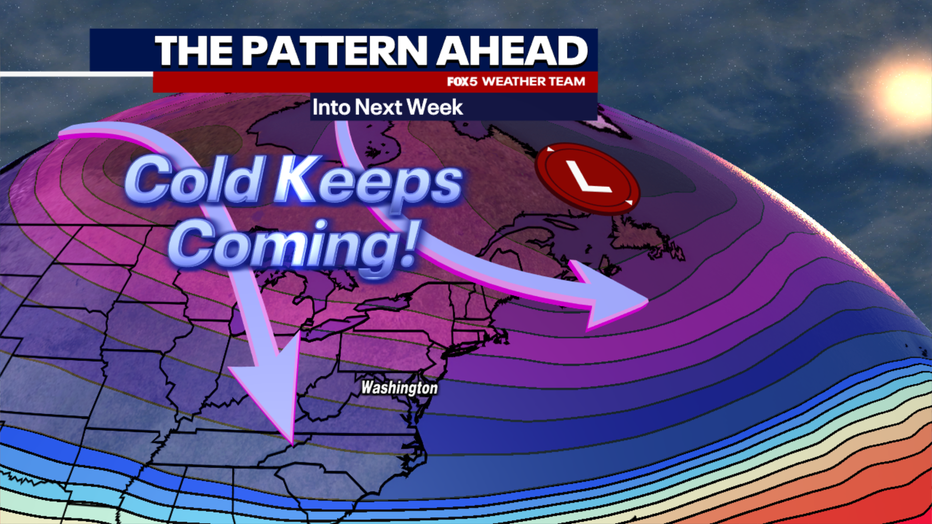
Regardless of how much, or if any, snow falls in our region, we do want to note that beyond the weekend we are expecting bitterly cold temperatures to continue for much of next week.
Lows in the teens and single digits look very possible, especially if we have a snowpack, while daytime highs stay below freezing for much of the week. That means any snow that does fall is not likely to melt away anytime soon.
The FOX 5 Weather Team will continue to keep you up to date with the latest weather updates as this potential significant winter storm draws closer. Stick with us here and on Fox Local for updates all week long! The FOX LOCAL app is your source for live FOX 5 DC weather updates — download here.