

DC Winter 2025-2026: Here's what weather models say about snow, cold, and storms
WASHINGTON - We are just about a month into autumn, but many minds are already shifting to the season ahead. Will winter be snowy and cold? Or dry and mild? What is some of the data suggesting that we could be in for in the weeks ahead?
JUMP TO: National Weather Service Model | American Model | European Model | La Niña or El Niño?
DC Winter 2025-26: Here's what weather models say about snow, cold, and storms
What is the National Weather Service saying about winter storms and temperatures?
A branch of the National Weather Service known as the Climate Prediction Center (CPC) focuses on long-range weather forecasting. While they do not forecast snowfall, they do forecast temperatures as a degree of confidence, in terms of above or below average temperatures.
For the upcoming winter, the early call from the CPC is for above normal temperatures this winter. Note that they do not mention how much above normal they expect temperatures to be, simply that above normal is favored. They also have the D.C. region in their lowest confidence level for above-normal temperatures, at just a 30-40% chance of above-normal temperatures.
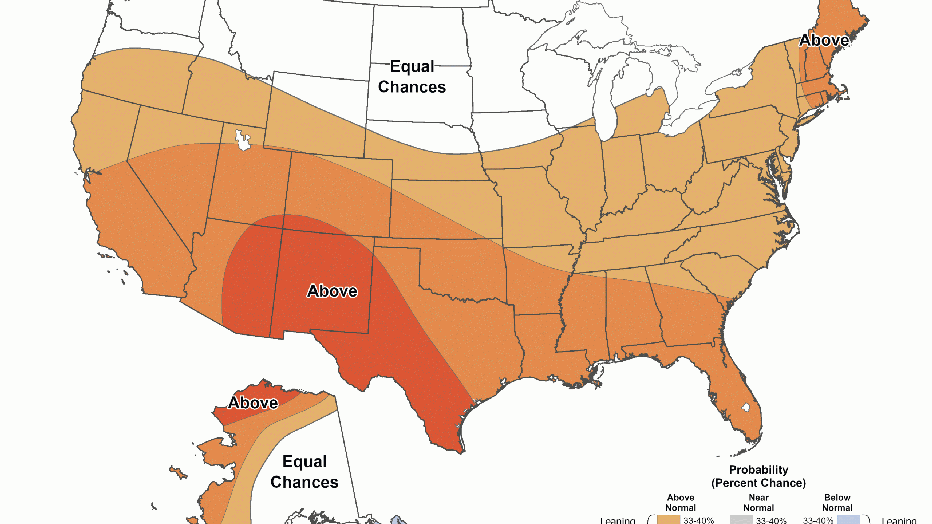
Note that such an outlook does not mean they favor warmth throughout the winter either, just that when the winter is said and done, they expect the average temperature for it to be above the 30-year average. Even the warmest winters do come with periods of cold weather. The low confidence to the forecast is a sign that they do expect some winter variability.
What about precipitation? Just like with temperatures, they simply categorize precipitation in terms of above and below the seasonal average. Currently, they have the D.C. region sitting under equal chances of above or below precipitation.
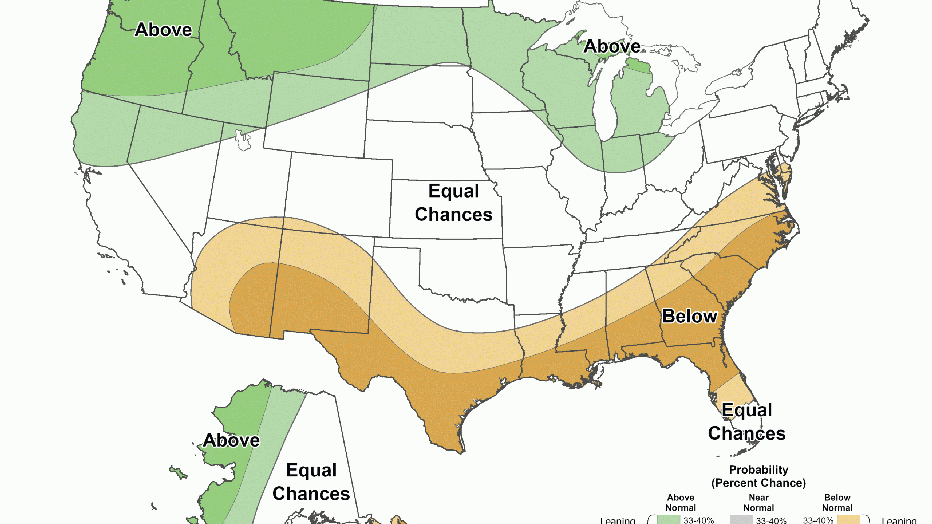
However, we can assess a little more by noting the position of the favored above normal zone to the northwest of our region, and the below normal zone southeast of our region. This means that they expect that the favored storm track this winter will be a more inland track, as opposed to a coastal track. While it is never a guarantee, this can be interpreted as a sign that the CPC is thinking there is a below-normal shot at those bigger coastal storms that can bring a lot of snow to our region. An inland storm track tends to bring more mix or rain as opposed to pure snow to our region.
American Model for Winter 2025-2026
Any seasonal weather model gives you what it believes the overall theme of winter will be, not saying that it is going to be the theme throughout the entire season. All seasons come with variability. The first model we look at here in the weather department is the American long range forecast model, called the Climate Forecast System (CFS).
DC Winter 2025-26: Here's what weather models say about snow, cold, and storms
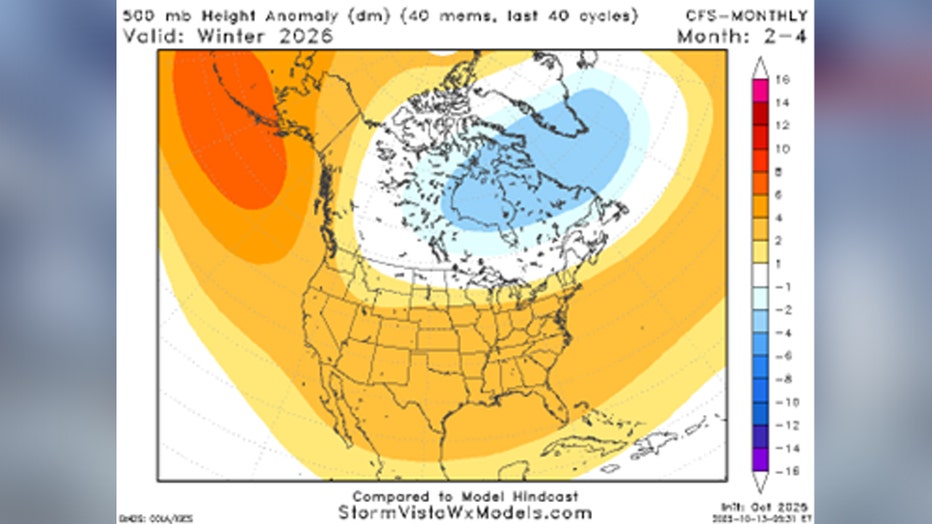
We typically start with the upper-level air pattern, as the pattern can help you determine the prevailing storm track, the strength of the polar vortex, and the source region for air masses during the winter season.
In the image above, the blue coloring around Greenland and the Hudson Bay in Canada suggest upper-level troughs to be favored in this region. These typically bring unsettled conditions and pushes of cold air. Notice though, the prevailing yellow golds throughout the United States. This suggests that these troughs may be more transient during the winter months, bringing periodic shots of cold, but the Jetstream would likely lift back northward rather quickly, allowing milder conditions to return rather quickly.
It also suggests that a key feature for East Coast winter storms, the North Atlantic Oscillation (NAO) will be predominantly in its positive phase. This is not ideal for snow lovers, as storms like nor’easters are more favored in a negative phase of the NAO. Still, it does not mean it is impossible. Back in 2016, for example, the winter was dominated by a positive NAO, before a brief but sudden spike in it helped set the stage for the January blizzard of 2016. Brief shifts in the pattern are sometimes all you need for a storm to develop, it is all about timing!
For those rooting for a colder winter, one sign to keep an eye on is all the yellow and orange you see around Alaska. This suggests that the Jetstream is favored to jump northward in this area, what we call an upper-level ridge and...as the atmosphere likes balance when the Jetstream goes northward in the West, it typically dips somewhere in the East. So this could be hinting at some periodic colder-than-expected periods in the East during the winter. If we can get some fracturing of the Polar Vortex to fracture a bit, cold periods may be further between, but when they strike, they could be quite cold.
For snow lovers though, the lack of any blue coloring in the Gulf of Alaska is a bit of a concern though, as it suggests a not-so-stormy season for the Pacific Northwest. This is key area forecasters watch as storms entering the United States off the North Pacific are what can power some of the more intense storms in the East during the wintertime. So, this could hint at a drier winter overall with lower threats for a big blizzard.
DC Winter 2025-26: Here's what weather models say about snow, cold, and storms
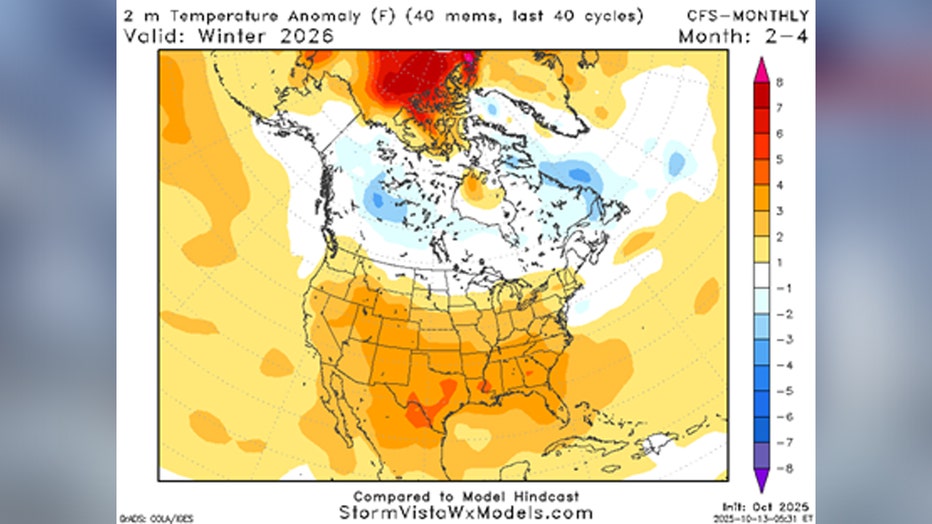
Not surprising given the discussion above, the model is favoring a predominantly warm winter overall for much of the United States, centered in the south. I will say this model is known for having a bit of a warm bias, but still, not the best look for cold weather lovers across much of the country. In D.C., it is favoring temperatures 2-3°F above normal for the winter ahead.
DC Winter 2025-26: Here's what weather models say about snow, cold, and storms
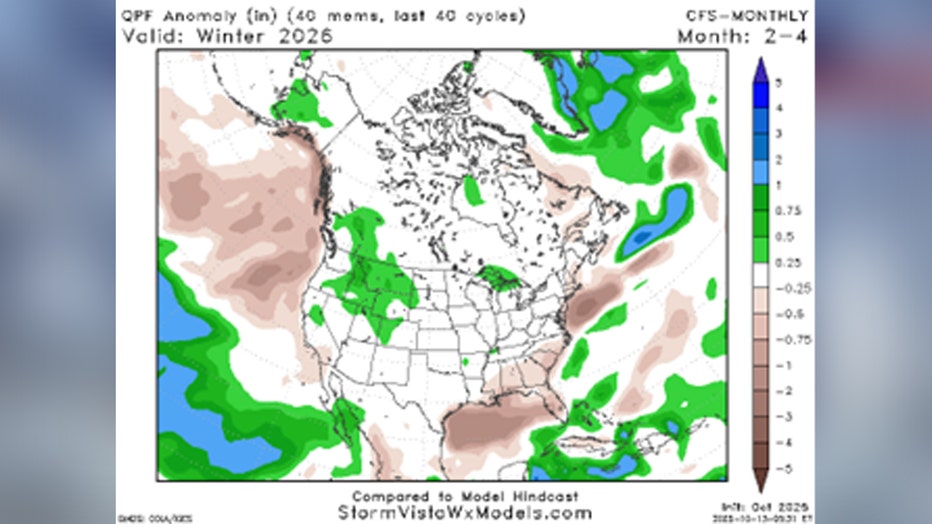
In terms of precipitation, it is very similar to the Climate Prediction Center outlook for the United States. Drier than normal conditions in the Southeast, with a bit wetter than normal in the interior and across in northern Rockies. For the D.C. region, it’s favoring average precipitation. Keep in mind this does not mean average snowfall though. Especially given the favoring for above normal temperatures. The bubble of "drier than normal" off the Mid-Atlantic and Northeast coastlines is not a favorable sign for coastal storms.
European Model on Winter 2025-2026
Another popular weather model is the European Model, which has its own long-range weather forecast model, known as the European Monthlies.
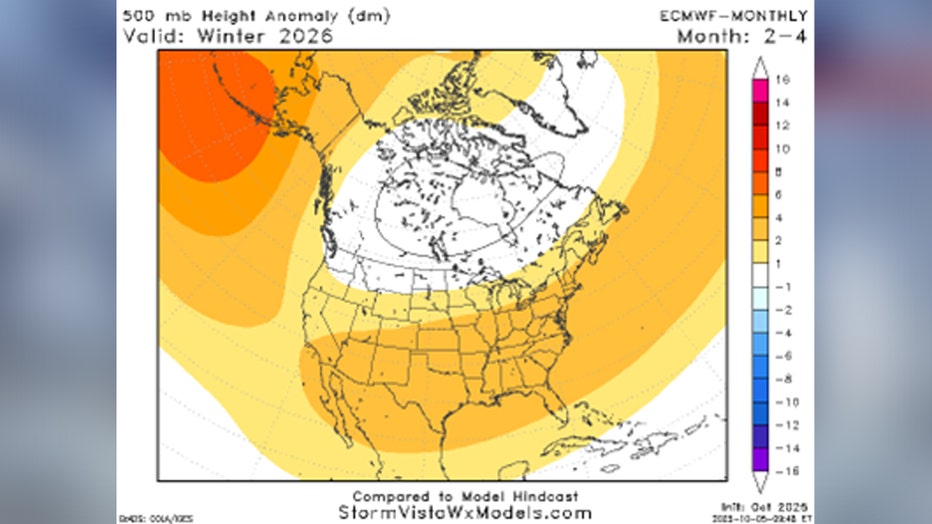
Starting with the upper-level charts, these generally show a very similar pattern to what the American CFS is suggesting for the winter ahead. Troughing, where you would expect to find more persistent cold, is focused more on central Canada as opposed to eastern Canada. When troughs are focused here, southwest flow does tend to dominate the weather in the eastern half of the United States. These favors ridge across the East, which tends to favor warmer and drier conditions.
DC Winter 2025-26: Here's what weather models say about snow, cold, and storms
Just like the CFS though, suggestions of ridging around the Bering Sea and Alaska suggest that periodic cold is likely. It just may be difficult to sustain for a long period of time if the Bering Sea ridge is persistent and sets up too far to the west. It would make the stronger cold more likely to dump into the Plains in the central part of the country than the eastern half.
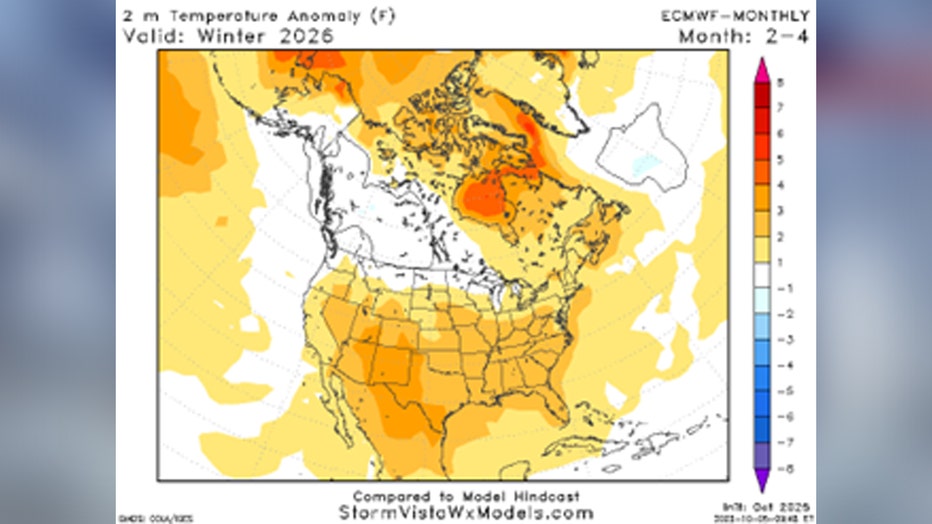
Unsurprisingly, the European model is also favoring a milder-than-normal winter across much of the country, also centered on the South and East. For the D.C. region, it suggests that the winter will be between 1-3° above the seasonal normal.
DC Winter 2025-26: Here's what weather models say about snow, cold, and storms
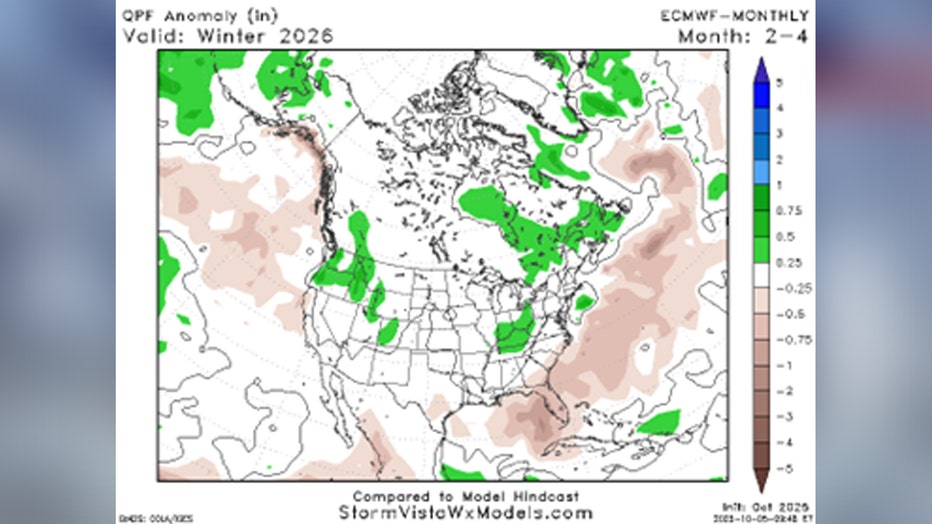
As far as precipitation is concerned, it’s very similar to both the CFS and CPC outlooks. Wetter with a focus on a storm track west of the Appalachian Mountains, with drier conditions for the immediate coastlines. This is fitting with suggested pattern, as storms that go up through the Midwest drag up mild gulf air on their eastern flanks, suggesting a winter where we are dealing with more mix or rain events than snow here in the Mid-Atlantic.
Are we experiencing an El Niño or La Niña weather pattern?
So why are the National Weather Service and the two major climate models showing a very similar forecast for the winter ahead? It’s likely because they are tapping heavily into the climatology related to a La Niña winter pattern.
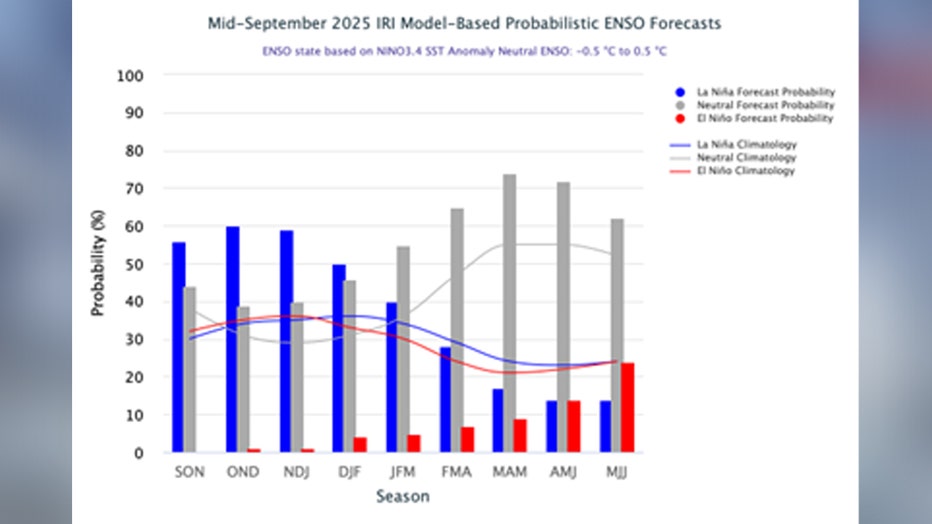
In their most recent report released on October 9th 2025, the Climate Prediction Center issued a La Niña Advisory and stated that "La Niña conditions are present and favored to persist through December 2025 - February 2026, with a transition to ENSO-neutral likely in January-March 2026". Despite this, they only give this forecast about a 55% confidence level, with most weather modeling (shown above) peaking La Nina at weak levels during the middle of the fall before weakening through the course of the winter. Weather models only are giving La Niña a 50/50 shot of lasting through the winter though.
DC Winter 2025-26: Here's what weather models say about snow, cold, and storms
A typical La Niña pattern does favor a pattern very similar to the ones that weather models are indicating as likely during the winter months. It favors a Jetstream that is farther to the north, with more typical "dips" in the jet across the Plains and Upper Midwest as opposed to the eastern half of the United States. This allows for some milder Gulf air to be more prevalent across the southern and eastern half of the country.
It is very likely that these climate models are showing what they are showing because they are putting heavy weight on La Niña conditions throughout the winter...perhaps too much weight given that La Niña conditions are currently very weak, and many climate models continue to weaken it through winter.
La Niña also tends to favor a storm track up through the interior Midwest, which as mentioned above, is not great for snowfall in our region. The last eight weak La Niña winters have failed to produce above normal snowfall in our region as the chart shows above.
DC Winter 2025-26: Here's what weather models say about snow, cold, and storms
Last winter, the pattern was close to but did not quite make La Niña status, something meteorologists sometimes refer to as a La Nada pattern. Flavors of La Niña, but not quite. D.C. did manage to have its first above normal snowfall in six years, with 14.9" of snow. Most of this fell in two storms: One in early January and the other in mid-February.
They were the only times that D.C. picked up over an inch of snow all season, with each storm dropping over 6" of snow. The two accounted for more than 91% of the total snowfall for the season last year. No storm in D.C. met blizzard criteria last season, nor has there been any storm since January 2016 that has.

DC Winter 2025-26: Here's what weather models say about snow, cold, and storms
This does not mean snow lovers cannot get a good snowfall this winter. It just means that, just like last winter, snow events may be more limited in number. D.C.’s 30-year average for snowfall exceeding one inch is just four days the entirety of the winter. Last year, it only happened twice, 50% of normal, which is something one may expect from a winter with a La Niña flavor. Despite this, we still managed to achieve above average snowfall for the first time since 2019. It takes one to two decent snow days to get us there.
And there may be more hope for snow lovers yet! La Niña is not the only thing we are watching as we approach the winter season. Our full winter weather outlook will be coming in the weeks ahead. Stay tuned for much more in the weeks ahead!

DC Winter 2025-26: Here's what weather models say about snow, cold, and storms
The Source: Information in this article comes from the FOX 5 Weather Team and the National Weather Service.