

What's changed? A look at safety measures around DCA 1 year after deadly plane crash
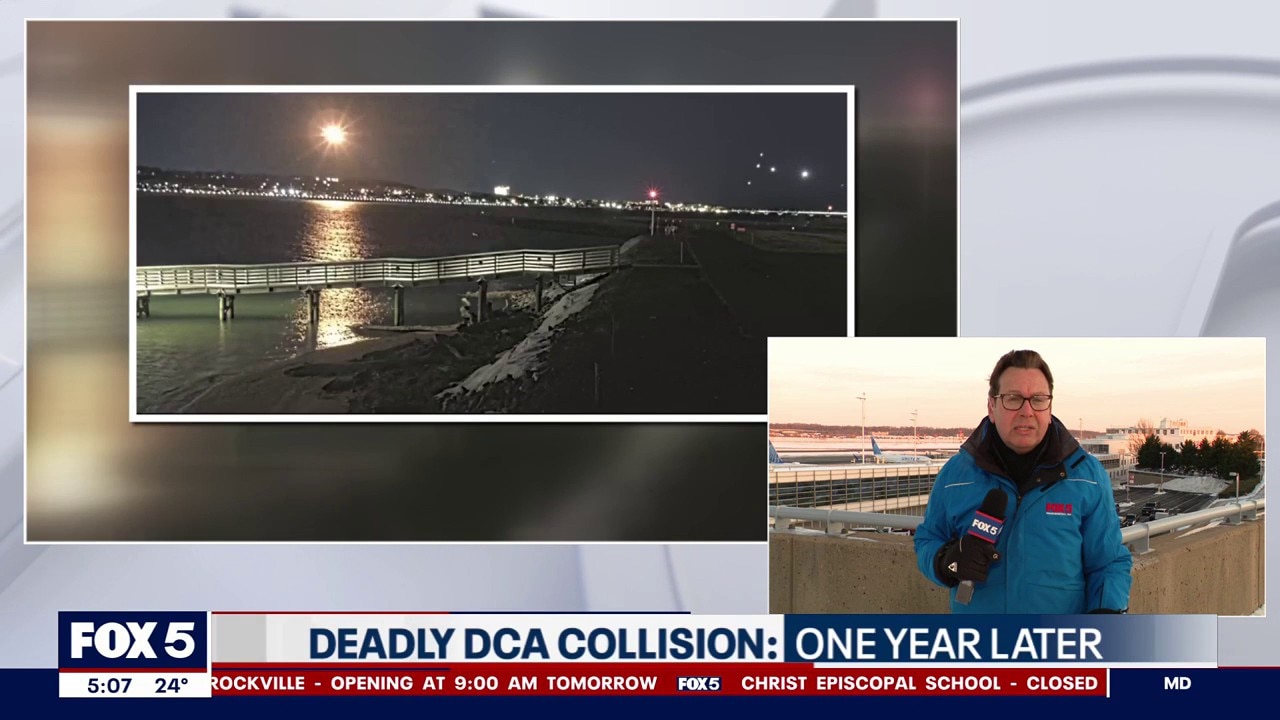
A look at safety measures around DCA a year after deadly plane crash
One year ago, 67 people lost their lives in a tragic mid-air collision between an American Airlines plane and an Army Black Hawk helicopter. The Federal Aviation Administration has pointed to a long-delayed upgrade to the nation’s air traffic control system, and says it plans to make continued improvements, but is it enough?
WASHINGTON - One year ago, 67 people lost their lives in a tragic mid-air collision between an American Airlines plane and an Army Black Hawk helicopter.
The Federal Aviation Administration has pointed to a long-delayed upgrade to the nation’s air traffic control system, and says it plans to make continued improvements, but is it enough?
The crash :
There were no survivors when an Army Black Hawk helicopter collided midair with American Eagle Flight 5342 as the jet made its final approach to Runway 33 at Reagan National. Both aircraft plunged into the icy Potomac River.
The FAA has since put in rules limiting helicopter traffic, air traffic control procedures and flight volume at Reagan National.
Airport officials echoed those changes on Thursday, but both Virginia senators, where this airport is located, say more needs to be done.
READ MORE: DCA deadly plane crash: Nation, DMV mark 1 year since midair collision over the Potomac
What they’ve done:
The FAA reduced the hourly arrival rates at DCA from 36 to 30 flights an hour, restricted helicopter near Reagan’s airspace, now requires choppers to broadcast their location.
It’s also increased staff in DCA’s air traffic control tower. There are 22 controllers working in the tower now, with eight in training, and just weeks ago FAA’s administrator detailed an overhaul of outdated radar and safety infrastructure.
"Immediately after the accident, did take immediate action, restricting non-essential helicopter traffic operations in the Capitol region, permanently closing certain helicopter routes," FAA Administrator Bryan Bedford said.
Local authorities say they’re working in conjunction with the FAA to improve safety.
"Our team is working closely with each other and with the aviation industry and government partners to embody a safety-first culture in everything we do," said Jack Potter, the president of the Metropolitan Washington Airports Authority.
READ MORE: NTSB outlines causes of deadly midair collision over DC at hearing
The problem:
But, Virginia’s senators tell FOX 5 a year after the disaster they’re frustrated that the Rotorcraft Operations Transparency And Oversight Reform Act, known as ROTOR Act, appears stalled in Congress.
The bill requires that aircraft be equipped with and use technology that transmits their position to others operating in the same airspace.
Sen. Mark Warner tells FOX 5 he’s angry over the delay.
"Many of the NTSB recommendations are in the ROTOR Act, which has already passed the Senate unanimously, and I don’t have the slightest idea why it hasn’t passed the House," Warner said. "It’s outrageous and it’s irresponsible."
One ongoing fight putting the Airport Authority, which operates DCA, and DMV political leaders on the same side is keeping a lid on the number of flights.
As recently as 2023, Congress tried to add flights to Reagan National, despite warnings that this airport was already too busy, and an increase would be too dangerous.
The Black Hawk helicopter involved in the collision was equipped with the technology but had a waiver that allowed it to operate without the technology switched on.
The ROTOR Act would close that loophole, undoing a provision inserted in a Department of Defense funding bill passed in December that sought to restore some of those exemptions.