

New Maryland laws taking effect on Jan. 1, 2026

MARYLAND - With the new year approaching, dozens of Maryland laws are set to take effect on Jan. 1, 2026. The updates cover health care, housing protections, insurance requirements and employment rules that will impact residents across the state.
New laws taking effect January 1
Homeowners and heirs receive new tax-sale protections — HB
Maryland’s HB 0059 strengthens protections for homeowners and heirs at risk of losing property through a tax sale. Beginning Jan. 1, counties must withhold certain owner-occupied homes and properties lived in by heirs from tax sale and create a registry that lets families formally flag their properties for protection.
The law also expands statewide rules that prevent low-balance tax debts from triggering a sale and updates notice and redemption requirements so owners and heirs have clearer information and more time to resolve tax issues before losing their homes.
Domestic violence awareness training required for barbers and cosmetologists — HB 1547
Beginning in 2026, Maryland will require applicants and license renewals in barbering and cosmetology to complete at least one hour of domestic violence awareness training, either in person or virtually.
"…requiring the Maryland Department of Labor to approve certain domestic violence awareness training that is offered in person and virtually, includes guidance on certain topics, and has a duration of at least 1 hour; etc."

NEW YORK, NEW YORK - JUNE 26: A view outside the Groomed Guys Mobile Barbershop truck as New York City moves into Phase 2 of re-opening following restrictions imposed to curb the coronavirus pandemic on June 26, 2020. Phase 2 permits the reopening of
Rideshare drivers receive weekly earnings summaries — HB 861
Transportation network companies must now provide drivers with weekly fare and earnings summaries, and report annual trip and earnings data to the Public Service Commission.
This bill was approved by the governor on May 13, 2025.
RELATED: New Virginia laws taking effect on Jan. 1, 2026

(AUSTRALIA OUT) Generic closed professions, doctors, medical surgery, 3 October 2000. AFR Picture by TANYA LAKE (Photo by Fairfax Media via Getty Images via Getty Images)
Health care changes
No prior authorization for pediatric hospital transfers — HB 1301
Maryland’s Medical Assistance Program, the Children’s Health Program and private insurers are prohibited from requiring prior authorization when a child needs to be transferred to a special pediatric hospital.
Under the Homecare Worker Rights Act of 2024, the Maryland Department of Health will only be allowed to reimburse residential service agencies (RSAs) for personal assistance services, like in-home care for elderly or disabled residents, when those services are provided by workers classified as employees, not independent contractors.
Firefighter cancer screenings must be covered — HB 459 / SB 374
Beginning January 1, 2026, Maryland will require counties that operate self-insured employee health plans to provide preventive cancer screenings for professional firefighters at no cost, including no copays, deductibles or coinsurance.
Dig deeper:
The law is a response to decades of data showing elevated cancer risk among firefighters due to repeated smoke and chemical exposure. SB 374 requires counties to follow nationally recognized medical guidelines when determining which screenings must be covered. Depending on a firefighter’s age, risk factors and length of service, these screenings may include:
- blood tests
- imaging studies (such as low-dose CT scans)
- other cancer-detection technologies as recommended by medical authorities
Under the bill, counties have two ways to meet the requirement:
- Provide a no-cost annual cancer screening program, or
- Apply for state grants to help pay for advanced screening tools and expanded firefighter health programs.
The law also directs the Maryland Health Care Commission to conduct a statewide study on firefighter cancer prevention efforts and issue a report by Dec. 1, 2028 evaluating the effectiveness of the screenings and whether additional protections are needed.
Supporters say the law ensures firefighters receive early-detection screenings that many would otherwise put off because of out-of-pocket costs. Counties will see some increased insurance and administrative costs, but the state determined that early cancer detection could ultimately reduce long-term treatment expenses.

Fire brigade fighting a fire generic firemen . (Photo by Jeff Overs/BBC News & Current Affairs via Getty Images)
Access to out-of-network specialists preserved — HB 11 / SB 902
Maryland makes permanent the rule allowing patients to receive in-network reimbursement when referred to certain specialists outside their insurance network, with limits on additional utilization review requirements.
Dig deeper:
This new Maryland law taking effect January 1 strengthens protections for patients who need to see medical specialists outside their insurance network. Under HB 11, patients may continue to receive in-network level coverage when they are referred to a nonparticipating specialist because no appropriate in-network provider is available.
The law prevents insurers from imposing extra utilization review hurdles or denying reimbursement simply because the specialist is out of network. It also requires insurers to assist patients in locating qualified providers and ensures that cost-sharing is treated the same as it would be for an in-network visit.
The goal is to stop balance billing, which is the practice where patients are billed for the difference between what their insurance covers and what the provider charges, in situations where a patient had no realistic ability to stay in-network.
By ensuring consistent coverage rules and eliminating financial penalties tied to network gaps, the law aims to protect Marylanders with complex or rare medical conditions who often cannot find needed expertise within their plan’s provider list.
Insurers cannot place time limits on anesthesia coverage — HB 1086
This new law requires health insurers to send both written and electronic notice when canceling or not renewing a small-group health plan. The notice must clearly explain the change and outline other coverage options available to employers.
The goal is to prevent small businesses from being caught off guard by a sudden loss of health coverage, giving them more time and information to secure a new plan and avoid gaps in employee insurance.
The bill was approved by the governor on May 20, 2025.
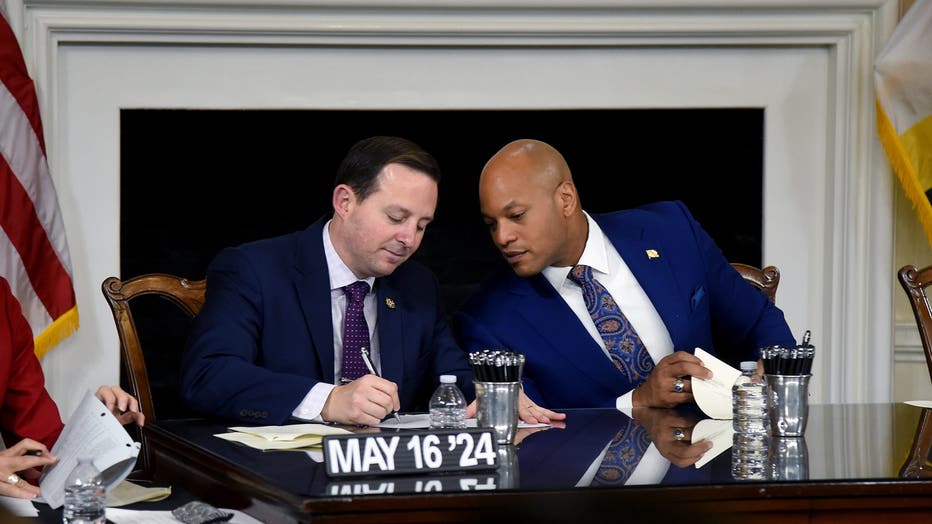
Senate President Bill Ferguson, left, and Governor Wes Moore, right, confer during a bill signing ceremony at the Maryland State House. (Barbara Haddock Taylor/The Baltimore Sun/Tribune News Service via Getty Images)
Expanded coverage for heart tests, insulin and cancer medications
Coronary calcium score testing coverage — HB 666 / SB 60
These companion bills require insurers, nonprofit health service plans and managed care organizations to cover coronary calcium scoring tests beginning January 1. The test is a noninvasive scan that measures calcium buildup in the arteries and helps determine a patient’s risk for heart disease.
Coverage must follow the latest American College of Cardiology guidelines, meaning insurers cannot deny the test for patients who meet those criteria. The goal is to expand preventive heart care and reduce out-of-pocket screening costs.
Insulin step-therapy ban — HB 970 / SB 646
This pair of bills prohibits insurers from requiring step therapy for insulin and insulin analogs used to treat Type 1 diabetes, Type 2 diabetes, or gestational diabetes.
Previously, some plans forced patients to try cheaper or alternative insulins before approving the medication their doctor recommended. Beginning January 1, doctors’ prescribed insulin must be covered without requiring those earlier "trial" medications, helping prevent delays in diabetes management.

NEW YORK, NEW YORK - MARCH 02: In this photo illustration, Elizabeth Snouffer, whose had type 1 diabetes for most of her life, displays her insulin capsule which she needs to take daily on March 02, 2023 in New York City. Drugmaker Eli Lilly announce
Step-therapy ban for metastatic cancer supportive drugs — HB 1087 / SB 921
These companion bills protect patients with stage 4 metastatic cancer by barring insurers from imposing step therapy for medications prescribed to treat symptoms or side effects of their cancer treatment. These are supportive drugs, not chemotherapy itself, but medications needed to manage pain, nausea, fatigue or other treatment-related conditions.
The law ensures physicians can prescribe the most effective supportive therapies without insurance-driven delays, improving comfort and continuity of care for patients with advanced cancer.
Oncology specialty drugs must be covered at in-network clinics — SB 975 / HB 1243
Insurers may not deny coverage for certain oncology specialty drugs administered at in-network oncology providers who meet state qualifications.
Expanded hearing aid coverage for adults — HB 1355 / SB 641
Maryland now requires health plans to cover medically necessary adult hearing aids when ordered, fitted and dispensed by a licensed hearing aid dispenser.

A hearing aid is placed in a man's ear. (Photo by: BSIP/Universal Images Group via Getty Images)
Additional notice required for canceled small-group health plans — HB 936
Insurers must provide both written and electronic notice when canceling or not renewing a small-group health plan, along with information about available coverage options.
Worker protections
Home-care workers must be classified as employees for reimbursement — HB 39 / SB 197
The Homecare Worker Rights Act requires residential service agencies to classify personal assistance workers as employees, not independent contractors, in order to receive state reimbursement.

Maryland State Flag
What’s next for Maryland's new laws?
Maryland officials say additional guidance will be released in the coming months as agencies, insurers and local governments implement the new requirements.
Residents are encouraged to review their health coverage, employment benefits and local county procedures ahead of January 1 to understand how the changes may affect them.
As more regulations and updates roll out, state agencies will continue outlining how these laws will be enforced throughout 2026.
The Source: This article is based on information from the Maryland Department of Legislative Services, bill tracking aggregators and health sites like Mayo Clinic.