

New USDA website centralizes info in fight against New World screwworm parasite threatening U.S. livestock
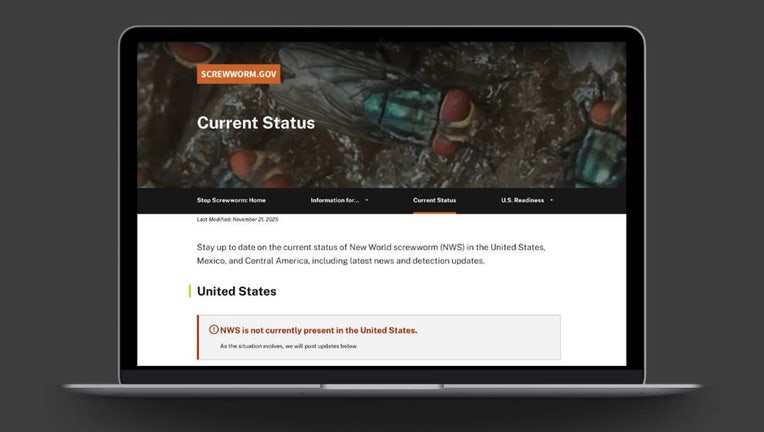
Screwworm.gov includes information from the Centers for Disease Control and Prevention, the Department of the Interior, the Food and Drug Administration, the Department of Energy, the Department of Homeland Security, the Environmental Protection Agen
The U.S Department of Agriculture (USDA) has launched a new website to centralize federal agencies as they work together to protect livestock, wildlife, and the public’s health against the New World screwworm parasite.
The backstory:
What is New World screwworm?
When NWS fly larvae (maggots) burrow into the flesh of a living animal, they cause serious, often deadly damage to the animal. NWS can infest livestock, pets, wildlife, occasionally birds, and in rare cases, people. This is a serious concern to the U.S. economy and the U.S. food supply and the United States Department of Agriculture (USDA) is committed to combatting the spread of NWS to protect American agriculture.
"We do not take lightly the threat NWS poses to our livestock industry, our economy, and our food supply chain, said U.S. Secretary of Agriculture Brooke L. Rollins. "The United States government will use all resources at its disposal to push back NWS."
Animals and humans become infected with New World screwworm (NWS) when the parasite lays eggs on and in open wounds. NWS can infest livestock, pets, wildlife, occasionally birds, and in rare cases, people. The FDA says NWS does not regularly occur in the U.S. and is typically found in South America and the Caribbean, but Mexico and countries in Central America are reporting cases in both humans and animals. People who travel to areas where the flies are present, have an open wound, spend time among livestock animals, or sleep outdoors, are at greater risk of NWS infection.
The USDA says NWS is a serious concern to the U.S. economy and the U.S. food supply and the agency is committed to combatting the spread of NWS to protect American agriculture.
RELATED: FDA issues emergency use authorization for drug to treat puppies and dogs infected with New World screwworm
RELATED: FDA authorizes drug to treat cats and kittens infected with New World screwworm
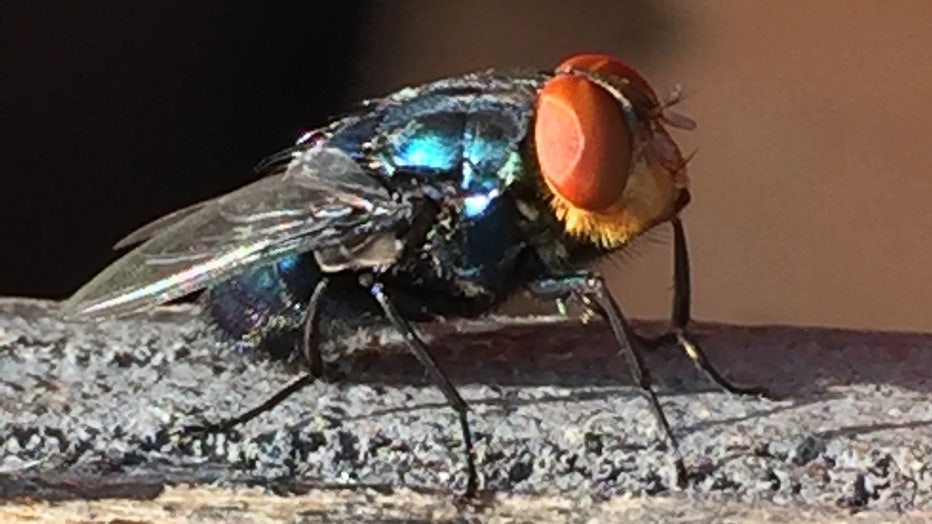
New World screwworm flies are about the size of a common housefly (or slightly larger) with orange eyes, a metallic blue or green body, and three dark stripes along its back. (USDA)
Dig deeper:
Symptoms of New World Screwroom infection
The Centers for Disease Control and Prevention (CDC) says people with an NWS infestation may see maggots around or in an open wound or in their nose, eyes, or mouth.
The CDC says NWS infestations are very painful. Symptoms can include
- Feeling maggots (larvae) moving within a skin wound or sore, ears, nose, eyes, or mouth.
- Seeing maggots around or in open sores.
- Painful skin wounds or sores.
- A foul-smelling odor from the site of the infestation.
- Unexplained skin wounds or sores that do not heal or worsen within a few days.
- Bleeding from open sores.
Bacteria can also infect wounds where NWS maggots are present and may cause fever or chills.
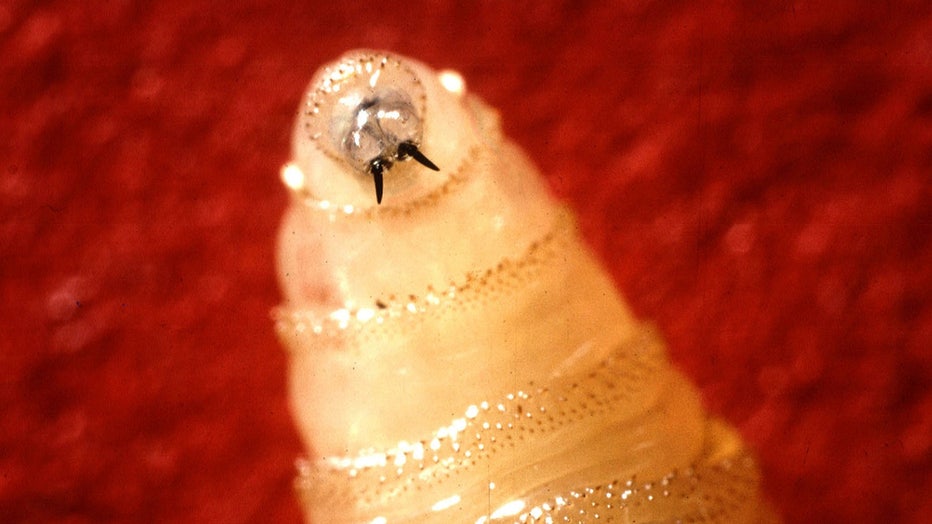
New World screwworm larvae (maggots) cause extensive damage by tearing at tissue with sharp mouth hooks. The wound can quickly become enlarged and deeper as more maggots hatch and feed on living tissue. (USDA)
The New World screwworm (NWS) website, screwworm.gov, centralizes NWS information available across the federal government and reflects a whole-of-government effort to fight the pest through implementation of Secretary of Agriculture Rollins’ five-pronged plan.
What's next:
USDA’s Five-Pronged Plan to address New World screwworm
1. Stop the Pest from Spreading in Mexico and Ensure We Are Full Partners in Eradication
- USDA’s recent $21 million expenditure went toward renovating an existing fruit fly production facility in Metapa, Mexico, which will provide an additional 60-100 million sterile flies a week to stop the spread, on top of the over 100 million already produced in Panama. This will result in at least 160 million flies per week.
- Over the last two weeks, USDA conducted a robust, in-person audit of Mexico’s animal health controls and will maintain close continual monitoring of these aspects moving forward and will make continuous improvements. These in-person visits have allowed a unique opportunity for APHIS to see first-hand the challenges and opportunities in Mexico toward combating NWS.
- USDA is working closely with Mexico to improve its surveillance and detection of NWS, which includes but is not limited to regularly providing traps, lures, and technical expertise to Mexico.
2. Protect the U.S. Border at All Costs
- USDA will support Mexico’s strategic trapping along our shared border and ensure we receive regular reporting as an early warning intervention.
- USDA will escalate communications and public outreach along the U.S.-Mexico border to create a "barrier zone of vigilance" and boost as close to real time as possible awareness of this pest.
- APHIS cattle fever tick riders in collaboration with U.S. Customs & Border Protection and with state partners will intercept and treat stray and illegally introduced livestock.
3. Maximize Our Readiness
- USDA will partner with state animal health officials to update and finalize emergency management plans and support federal, state, and local responders in training on and practicing for a potential response.
- USDA will ensure we have sufficient NWS treatments and will work to remove any federal regulatory hurdles for their use.
4. Take the Fight to the Screwworm
- Because sterile NWS flies are one of the most important and proven tools we have for eradicating the pest, USDA will immediately begin building a sterile insect dispersal facility at Moore Air Base, set to be completed in 2025. This facility will have the capability to disperse sterile flies in Northern Mexico.
- USDA is exploring all options to eradicate NWS, which includes potential expenditures in new technologies, new science, including possible plans to move forward with the design process of a domestic sterile fly production facility to compliment the new dispersal facility at Moore Air Base which has also been identified as the proposed location. The facility could boost domestic sterile fly production by up to 300 million flies per week and could complement current production that already exists in Panama and Mexico.
5. Innovate Our Way to Eradication
- USDA is pursuing innovative research to improve sterile insect technology, exploring development of better traps and lures, exploring next generation NWS treatments, and assessing the potential use and practicality of additional strains or genetically modified versions of the pest as well as e-beam and other radiation technology for the production of sterile flies.
- USDA will strengthen partnerships with land-grant universities in border states such as Texas, Arizona and New Mexico to facilitate local training, trap deployment, surveillance validation, and stakeholder outreach as an initial manner
Screwworm.gov includes information from the Centers for Disease Control and Prevention, the Department of the Interior, the Food and Drug Administration, the Department of Energy, the Department of Homeland Security, the Environmental Protection Agency, and the Department of State.
USDA says it will continue to work with all partner agencies to update and enhance the website, ensuring it has the latest information and updates.
The Source: Information in this article was provided by the U.S. Department of Agriculture (USDA). This story was reported from Orlando.