

Virginia energy plan targets rising power demand, affordability and data-center costs
Virginia governor unveils new energy plan amid data center boom
Virginia Governor Abigail Spanberger unveiled a new energy plan amid a data center boom in the Commonwealth.
RICHMOND, Va. - Virginia has released a new energy plan that lays out how the commonwealth intends to meet rapidly rising electricity demand while keeping power reliable, affordable and on track for its clean-energy goals.
Virginia is required by law to update its energy plan every four years. The 2026 Virginia Energy Plan relies on energy efficiency, solar power, battery storage and better use of the existing grid in the near term, while calling for longer-term investment in advanced nuclear energy, offshore wind and long-duration storage.
The unveiling follows a busy, energy-focused summer for the administration, during which Governor Abigail Spanberger returned Virginia to the Regional Greenhouse Gas Initiative, became a party to the proposed $67 billion Dominion/NextEra Energy merger, and introduced a data center accountability framework for the Commonwealth.
"We have been engaging on issues across the board related to energy affordability, our infrastructure, allocation of costs and recently and notably our comments to the SCC related to transmission costs as it relates to Data Center transmission," Gov. Spanberger said.
What the plan says about data centers
What we know:
Virginia Energy’s modeling found that serving projected data-center demand could account for roughly half of the new system-wide costs under its moderate growth outlook, or about $200 billion.
The plan says an average 1-gigawatt data center pays about $700 million a year for electricity under existing cost-allocation rules. At roughly 20 gigawatts of projected demand, new data centers could generate about $265 billion in electricity revenue through 2050, the plan states.
READ MORE: Virginia introduces new AI data center regulations
State officials say that money could help fund new generation and grid investments if costs are assigned appropriately, rather than shifted to households and small businesses.
The plan also recommends requiring new large data centers to show they can reduce or shift electricity use during periods of high demand or grid emergencies.
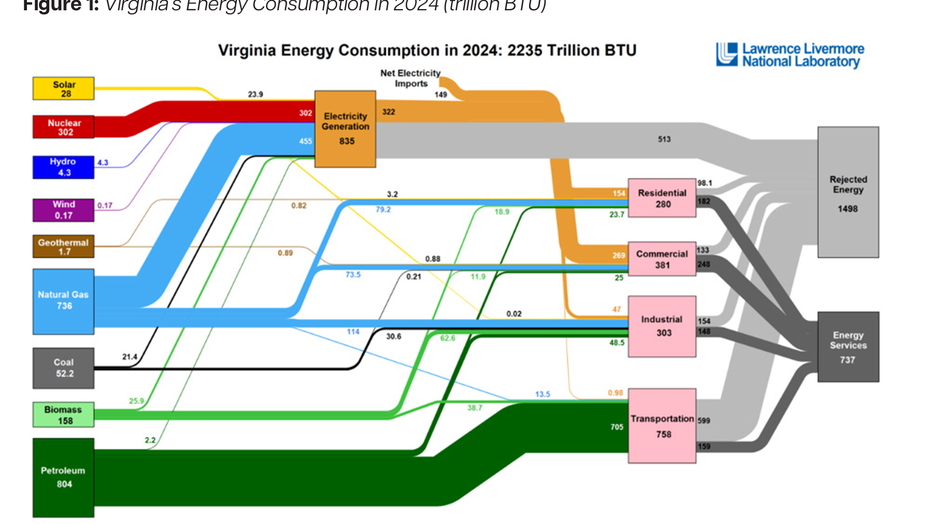
Virginia’s electricity system is changing as growing demand drives more solar, battery storage and other power resources, according to the state’s 2026 Energy Plan.
What it could mean for electric bills
By the numbers:
About 17% of Virginia households, more than 550,000, spend more than 6% of their income on home energy costs, according to the executive brief.
Under status quo conditions, utility plans project residential electricity prices could rise about 60% for Dominion Energy customers and about 17% for Appalachian Power customers during the next decade as utilities replace aging equipment and build infrastructure to serve rising demand.
The plan says its recommendations are intended to help reduce those projected increases by prioritizing lower-cost power sources, increasing energy efficiency, improving use of the existing grid and requiring fairer cost allocation for major new customers.
What the plan proposes
Dig deeper:
Virginia’s plan recommends more solar power, battery storage, energy-efficiency upgrades and distributed energy resources such as rooftop solar, smart devices and virtual power plants.
For longer-term reliability, it also calls for development of clean firm power sources, including advanced nuclear energy, offshore wind and long-duration energy storage.
The plan projects Virginia will need to more than double its existing power-generation capacity to meet expected growth and clean-energy goals. It estimates the buildout could require 5,000 to 20,000 construction jobs each year over the next two decades and create roughly 20,000 permanent operations jobs.
What's next:
Many of the plan’s recommendations would require action by state agencies, utilities, regulators or local governments. Because the roadmap is an advisory plan rather than a law or executive order, it does not require approval from the General Assembly.
Virginia Energy said it developed the plan using public feedback and modeling of several possible paths for the state’s power system through 2050.
With Virginia governors limited to a single term, questions remain regarding how much of the blueprint can be implemented with little over two years left in Spanberger's term.
What they're saying:
Supporters have praised the blueprint's ambitious scope. Delegate Rip Sullivan (D-Fairfax County) noted that the Commonwealth had been "stuck in neutral in terms of our drive towards meeting our clean energy goals here in Virginia," adding that he believes the state is now "back on track."
However, skeptics raised questions about the plan's feasibility and economic impact. Jason Hayes of the Heritage Foundation warned against aggressive carbon mandates, saying, "Pretty much every time states move to these NetZero plans, essentially what happens is that prices go up and reliability goes down."
Read the 2026 Virginia Energy Plan Executive Brief
The Source: This article was written using information from Virginia Energy’s 2026 Energy Plan and executive brief.