

With 'Trump Accounts,' your child could qualify for $1,000: What to know

POTUS unveils $6.25B Dell pledge to "Trump Accounts"
Billionaires Michael and Susan Dell pledged $6.25 billion Tuesday to provide 25 million American children under 10 an incentive to claim the new investment accounts for children created as part of President Donald Trump’s tax and spending legislation.
All children born between 2025 and 2028 will receive a baby shower gift from President Donald Trump: a $1,000 deposit into a "Trump Account."
And thanks to a historic donation announced Tuesday by billionaires Michael and Susan Dell, that balance could get even bigger.
Here's what you need to know about Trump Accounts and how to claim them.
What is a Trump Account for kids?
Big picture view:
"Trump Accounts," a bill signed into law earlier this year, gives $1,000 to every newborn, so long as their parents open an account.
That money is invested in the stock market by private firms, and the child can access the funds when they turn 18. The parents of older children can also open accounts, but they won't get the $1,000 bonus.
Backers say it's a way to bolster capitalism and help children from low-income households build wealth.
The new program gives the $1,000 bonus only to babies born during the calendar years of the Trump administration.
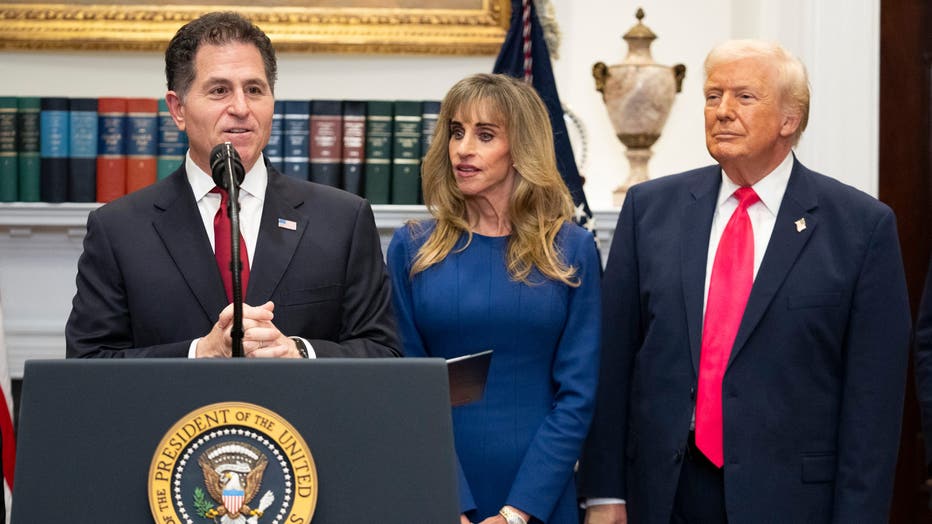
President Donald Trump and Susan Dell look on as Michael Dell speaks about his $6.25 billion donation to fund investment accounts for millions of U.S. children at the White House in Washington, DC on December 2, 2025. (Credit: Carolyn Van Houten/The
In addition, the child can only use the money for specific purposes, such as paying tuition, starting a business or making a down payment on a home.
After a parent opens an account, the U.S. Treasury will contribute $1,000 for newborns. Private banks and brokerages will manage the money, which must be invested in U.S. equity index funds that track the stock market and charge the accounts no more than 0.10% in annual fees.
Parents can contribute up to $2,500 annually in pretax income, much like they do for retirement accounts. Parents' employers, relatives, friends, local governments and philanthropic groups can also pitch in. Yearly contributions are capped at $5,000, but contributions from governments and charities don’t count toward that total.
What about older children?
Dig deeper:
Children born before 2025 won't qualify for the $1,000 incentive, but parents can still open accounts for them as long as they're under 18. In addition, parents can still invest up to $2,500 pretax for those kids.
And thanks to a historic donation announced Tuesday by the Dell family, some children 10 and under may receive an additional $250 in seed money if their parents open an account.
RELATED: Michael and Susan Dell pledge $6.25B for children’s investment accounts in Trump program
That money is reserved for kids who live in ZIP codes with a median family income of $150,000 or less and who won’t get the $1,000 seed money from the Treasury.
What they're saying:
"We believe that if every child can see a future worth saving for, this program will build something far greater than an account. It will build hope and opportunity and prosperity for generations to come," said Michael Dell, the founder and CEO of Dell Technologies whose estimated net worth is $148 billion, according to Forbes.
"We want these kids to know that not only do their families care, but their communities care, their government, their country cares about them," said Susan Dell. "And we’re all rooting for them to have a wonderful future, a bright future, and that that’s available to them."
How do I open a Trump Account for my kids?
What you can do:
The accounts won't be open for contributions until July 2026. But parents of eligible kids can sign up now by filling out Form 4547 from the Internal Revenue Service. As of Wednesday afternoon, that form was not yet available on the Trump Accounts website.
In May, parents who sign up will get information about how to finish opening the accounts.
Beginning in July, the White House says it will have a website where parents can register for the accounts.
What's the idea behind the accounts?
What they're saying:
Backers of the accounts say they want to introduce more people to the stock market and give even children born into poverty a chance to benefit from it.
They believe that giving every newborn $1,000 will help combat the rising popularity of socialism and offer more people the opportunity to build wealth.
About 58% of U.S. households held stocks or bonds in 2022, according to the U.S. Securities and Exchange Commission, though the wealthiest 1% owned almost half the value of stocks in that same year.
Before Trump created the accounts, California, Connecticut and the District of Columbia were piloting "baby bonds" programs that are similar to Trump Accounts in some ways. Several other states, including Maryland, are weighing programs.
But those programs are targeted for youth growing up in poverty or foster care, plus children who lost a parent to COVID-19. Wealthier children don't benefit. They're also managed by the state, not private investment firms.
The other side:
Critics point out the accounts do little to help children in their early years, when they're most vulnerable and most likely to be in poverty. They also say the accounts do little to offset the cuts the Trump administration and congressional Republicans have made to other programs that benefit young people and their families, including food assistance and Medicaid.
And even with the contribution from the government, critics say the Trump Accounts will widen the wealth gap. Affluent families that can afford to make the maximum pretax contribution to the accounts will realize the greatest benefits. Poor families who can't afford to set aside money for the accounts will benefit the least. Assuming a 7% return, the $1,000 in seed money would grow to roughly $3,570 over 18 years.
The Source: This story was reported from Los Angeles. The Associated Press, previous FOX Local reporting contributed.