

Iowa lead explosion: How far will toxic dust travel? See county maps

Iowa lead explosion scheduled: What you need to know [FULL]
Full presser from the U.S. Army and public officials on the scheduled Iowa lead detonation.
MIDDLETON, Iowa - After a week of legal and political fallout, the U.S. Army plans to detonate nearly 10,000 pounds of bomb-making material at its ammunition plant in Middletown, Iowa, on Wednesday, Nov. 25.
The controlled blast on Nov. 25 will destroy 68 barrels of lead azide, a highly volatile chemical compound used to ignite ammunition.
When will the Iowa lead detonation begin?
What they're saying:
Army officials announced the controlled explosion will take place at approximately 9:00 a.m. CST.
During a Tuesday morning press conference, Acting Army Secretary Adam Telle said they chose to conduct the operation at this time because forecasted weather patterns should be ideal "to protect public health and safety across the region."
Lead azide is extremely sensitive to sudden temperature changes, and the Army said it's prepared to move the time of the detonation depending on how the weather plays out.
How far will the lead azide dust travel?
Dig deeper:
According to updated Army tracking maps issued Wednesday morning ahead of the detonation, a cloud of airborne lead dust is projected to travel southwest from the Middletown site into northeastern Missouri.
Heavier dust particles are expected to settle on the ground across a 186-square-mile strip stretching through Des Moines and Lee counties in southeastern Iowa and just across the state line into northern Clark County, Missouri.
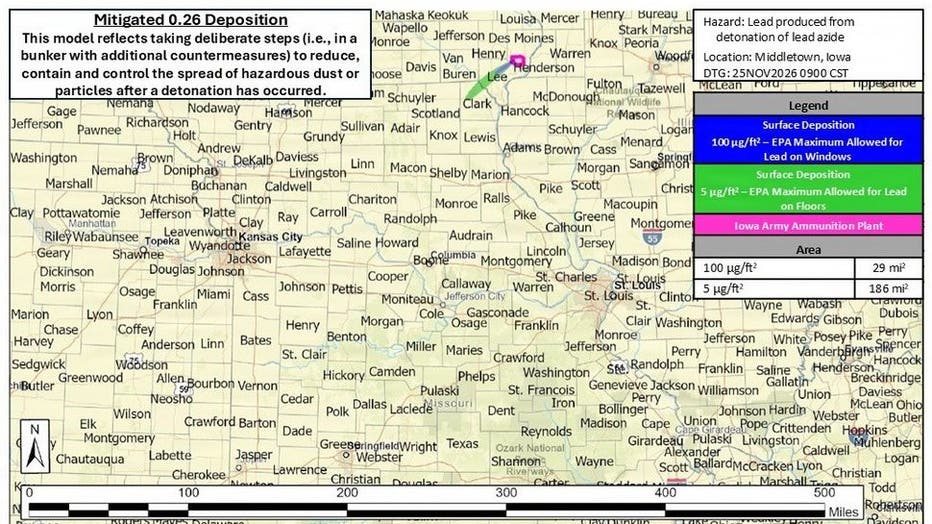
The map shows which counties in southeastern Iowa and northeastern Missouri could see heavy lead dust settle on the ground following the Army's controlled detonation of lead azide at its ammunition facility in Middletown, Iowa. (Credit: U.S. Army)
Lighter dust floating in the air could drift much farther southwest over the next several hours, crossing through Clark, Scotland, Lewis and Knox counties before reaching Shelby and Macon counties in northeastern Missouri about five hours after the blast.
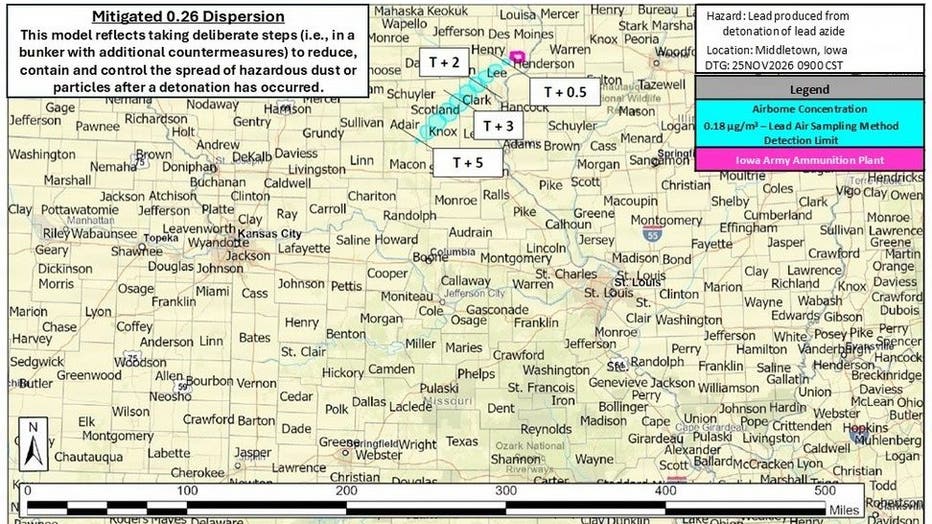
The map shows how far fine airborne lead particles could drift across northeastern Missouri over five hours following the Army's controlled detonation of lead azide at its ammunition facility in Middletown, Iowa. (Credit: U.S. Army)
Because the path depends on shifting wind conditions, the Army is issuing updated maps every hour until the detonation occurs, followed by a final post-blast estimate.
Anyone living inside those mapped zones, especially families with young children, should avoid the area or stay inside with their windows and doors shut until the Army says the air is safe again.
Why the Army says the blast can't wait
The backstory:
Military leaders and local officials maintain that delaying the controlled detonation poses an immediate, catastrophic threat to plant workers and nearby residents.
"Everyone that we've spoken to, through their experience, has determined that this is the only safe path forward for not only the surrounding community of Middletown …but also the personnel that are tasked with mitigating this threat here on base," said ATF director Robert Cekada during a Tuesday morning press conference.
According to the Army, the lead azide has sat in storage bunkers for decades, degrading into irregularly shaped crystals that are extraordinarily sensitive to friction, shock and static electricity.
"Inaction is no longer an option," said Major General Eric Shirley, who's leading the operation. "It would be irresponsible for us to not take the determined, consensus-based course of action moving forward that has been selected."
Court ruling changed detonation plans
Timeline:
On Monday, Nov. 23, the 8th U.S. Circuit Court of Appeals cleared the way for the U.S. Army to detonate the lead azide.
President Donald Trump said the order was one of two decisions he was waiting for after he told the Army earlier in the day not to move forward without court approval.

Iowa ammunition plant detonation gets appeals court approval
The U.S. Army plans to detonate seven tons of unstable bomb-making material at an Iowa ammunition plant after a federal appeals court approved moving forward. The operation involving 68 barrels follows repeated delays, public concern and an environmental lawsuit. Army officials warn the material could explode spontaneously if left in storage or moved.
The detonation was first planned for last Friday, Nov. 20, but the U.S. Army has changed the date three times after public concern about possible health and environmental effects.
Before the ruling, environmental groups challenged an emergency permit from the U.S. Environmental Protection Agency that cleared the operation. The court temporarily halted that permit, and the U.S. Army then argued it did not need that authorization because officials considered the situation an emergency.
The Source: Information from the U.S. Army and previous FOX Local reporting contributed to this story, which was written in Eden Prairie, Minnesota.