

Viola Ford Fletcher, Tulsa Race Massacre survivor, dies at 111

1921 Tulsa Race Massacre survivor dies at 111
One of the last survivors of the 1921 Tulsa Race Massacre in Oklahoma, Viola Ford Fletcher, who spent much of her life pursuing justice for the attack she and her community experienced, has died at the age of 111. She was 7 years old when the two-day attack began on Tulsa's Greenwood district on May 31, 1921. LiveNOW’s J Russell is learning about the life and legacy of Viola Ford Fletcher with someone who knew her, Terry Baccus, who is a Black Wall Street Tour Guide.
Viola Ford Fletcher, the oldest living survivor of the Tulsa Race Massacre, died on Monday. She was 111 years old.
Her grandson Ike Howard confirmed the news, sharing that she died surrounded by family at a Tulsa, Oklahoma hospital.
Oldest living survior of Tulsa Race Massacre dies
Dig deeper:
Fletcher was 7 years old when the two-day attack began on Tulsa’s Greenwood district on May 31, 1921, after a local newspaper published a sensationalized report about a Black man accused of assaulting a white woman.
As a white mob grew outside the courthouse, Black Tulsans with guns who hoped to prevent the man’s lynching began showing up. White residents responded with overwhelming force.
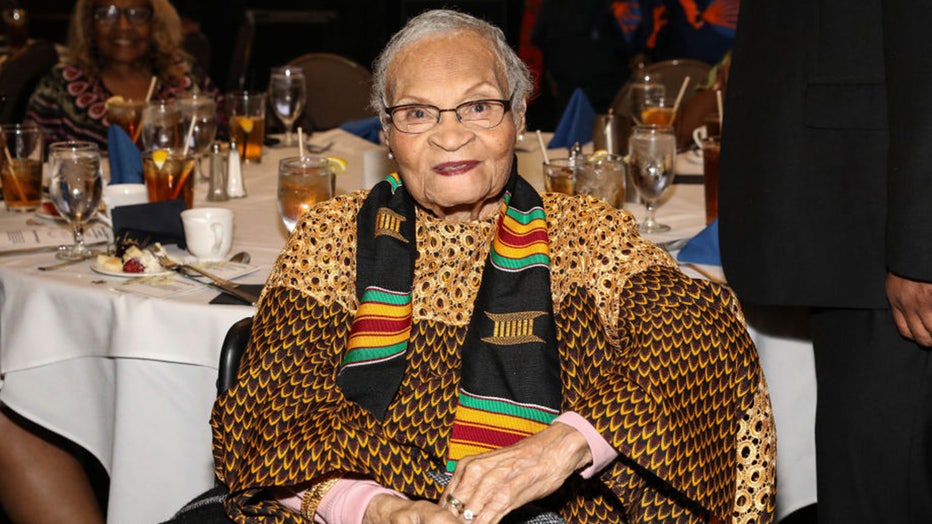
FILE - Queen Mother and Founder of the VFF Foundation, Viola Ford Fletcher, age 108, attends the Oldest Living Tulsa Oklahoma Massacre Survivors Celebrated And Book Cover Revealing at The City Club of Washington on Feb. 28, 2023 in Washington, DC. (P
Hundreds of people were killed and homes were burned and looted, leaving over 30 city blocks decimated in the prosperous community known as Black Wall Street.
"I could never forget the charred remains of our once-thriving community, the smoke billowing in the air, and the terror-stricken faces of my neighbors," Fletcher wrote in her 2023 memoir, "Don’t Let Them Bury My Story."
As her family left in a horse-drawn buggy, her eyes burned from the smoke and ash, she wrote. She described seeing piles of bodies in the streets and watching as a white man shot a Black man in the head, then fired toward her family.
What they're saying:
Tulsa Mayor Monroe Nichols said the city was mourning her loss.
"Mother Fletcher endured more than anyone should, yet she spent her life lighting a path forward with purpose," he said in a statement.
Tulsa Race Massacre
The backstory:
The attack went largely unremembered for decades. In Oklahoma, wider discussions began when the state formed a commission in 1997 to investigate the violence.
Fletcher, who in 2021 testified before Congress about what she went through, joined her younger brother, Hughes Van Ellis, and another massacre survivor, Lessie Benningfield Randle, in a lawsuit seeking reparations. The Oklahoma Supreme Court dismissed it in June 2024, saying their grievances did not fall within the scope of the state’s public nuisance statute.
RELATED: Tulsa mayor unveils plan for $100M trust to 'repair' effect of 1921 Race Massacre
"For as long as we remain in this lifetime, we will continue to shine a light on one of the darkest days in American history," Fletcher and Randle said in a statement at the time. Van Ellis had died a year earlier, at the age of 102.
A Justice Department review, launched under the Emmett Till Unsolved Civil Rights Crime Act and released in January 2024, outlined the massacre's scope and impact. It concluded that federal prosecution may have been possible a century ago, but there was no longer an avenue to bring a criminal case.
The Source: This story was reported from Los Angeles. The Associated Press contributed.