

Annual report reveals cities with best, worst commutes for 2025
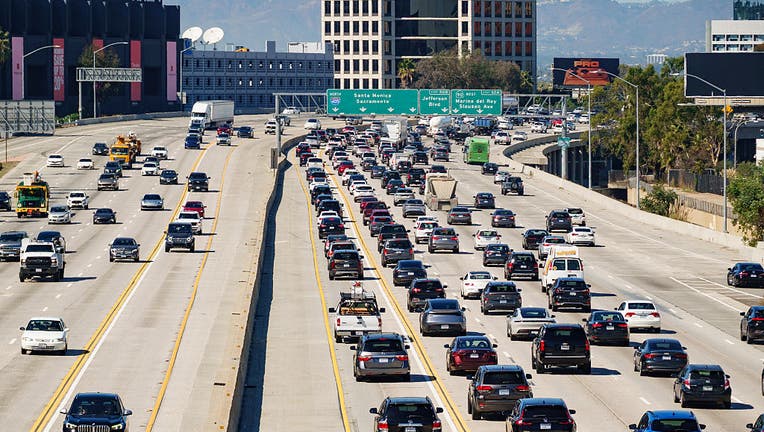
Traffic backs up on northbound Interstate 405 on October 17, 2025 in Los Angeles, California. (Photo by Kevin Carter/Getty Images)
Commuting is getting worse or better in some large urban areas according to the Texas A&M Transportation Institute’s (TTI’s) latest Urban Mobility Report (UMR) 2025.
The 2025 UMR evaluates travel patterns across 494 urban areas in the U.S. based on 2024 data.
According to the report, Los Angeles commuters experience the most hours and traffic delays each year. That's followed by commuters in New York City. On the other end, commuters in San Diego and Detroit experience fewer hours in traffic delays.
By the numbers:
The report calculates how many hours total of traffic delays commuters experience.
Best cities for commuters (2025)
- San Diego (162,413,000 hours)
- Detroit (174,043,000 hours)
- Seattle (183.879,000 hours)
Worst cities for commuters (2025)
- Los Angeles (1,089,623,000 hours)
- New York (893,093,000 hours)
- Chicago (422,236,000 hours)
Americans lost a record 63 hours to traffic in 2024
Dig deeper:
Americans spent more time stuck in traffic last year than ever before, losing an average of 63 hours to congestion in 2024, according to the report.
That’s nearly eight full workdays wasted in traffic and represents a 16% jump in national congestion costs over the past five years, now reaching $269 billion a year.
Researchers said although traffic volumes are back to pre-pandemic levels, researchers say congestion now stretches beyond the typical weekday rush, spilling into midday, midweek, and even weekend hours.
What they're saying:
"The numbers show more traffic than we’ve ever seen, but also a different kind of traffic," David Schrank, TTI senior research scientist and lead author of the study, said in an online news release. "Hybrid work capabilities, online shopping and other changes in our daily lives have reshaped when and where congestion happens. This can create more unpredictability and make travel harder to plan."
Big picture view:
While traffic congestion has hit record highs nationwide, some regions are handling the increase better than others. Researchers say more drivers are traveling outside traditional rush hours — a trend likely tied to hybrid work schedules — which helps spread traffic throughout the day and ease pressure on peak periods. In other areas, however, delays have returned quickly despite similar shifts in travel behavior.
The 2025 Urban Mobility Report examines traffic in 494 U.S. cities and introduces a new way to measure movement called "observed access." By analyzing where trips begin and end, researchers can see how people actually travel and identify gaps that limit mobility — helping cities plan more effective improvements.
Key findings include a 19% rise in truck congestion since 2019, nearly double the 10% increase for all vehicles, as freight systems struggle with higher delivery volumes. The report also shows growing travel-time unpredictability across cities of all sizes.
Backed by the Texas Department of Transportation, the annual study builds on decades of data showing that congestion remains a stubborn challenge — particularly in fast-growing, economically vibrant regions.
What's next:
The 2025 report concludes there’s no one-size-fits-all solution to traffic congestion. Researchers recommend combining low-cost fixes, targeted road expansions, smarter technology, and development plans that match evolving travel habits.
"Congestion is a fact of life in thriving regions," Schrank added. "This year’s numbers challenge us to think differently about travel. Why are people on the road? Can we shift some of that demand, or give travelers more reliable options? We’re getting the tools and data to answer those questions and act on them in ways we couldn’t before."
The Source: The information in this story comes from the Texas A&M Transportation Institute’s 2025 Urban Mobility Report, an annual study sponsored by the Texas Department of Transportation. This story was reported from Los Angeles.