

Democrats win House and Senate - what this means for Trump's final two years
WASHINGTON - Democrats won control of both chambers of Congress following Tuesday’s midterm election, potentially setting up a divided final two years of President Donald Trump’s time in office.
By controlling both the House and the Senate, the Democrats gain control of the entire legislative branch of the government, giving them more leverage in budget negotiations and the ability to block Cabinet and judicial nominations, including those to the U.S. Supreme Court.
A recipe for gridlock and shutdowns?
Big picture view:
By taking control of Congress, Democrats secured the purse strings of government and gained the ability to negotiate on budget issues from a much stronger position.
LIVE: 2026 Midterm Election results
When it comes to legislation to keep the government funded, Trump will need to strike deals with newly emboldened Democrats, many of whom ran campaigns virulently opposing some of the president’s priorities. Trump has only needed to use his veto pen twice so far in his second term, but with Democrats controlling the House and Senate, they will be able to send more bills reflecting their priorities to his desk.
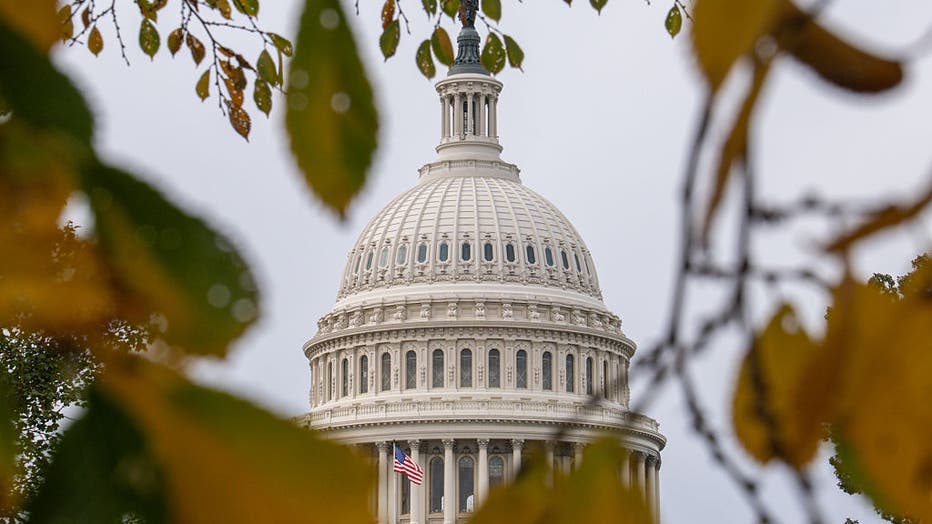
WASHINGTON, D.C., UNITED STATES - NOVEMBER 02: The U.S. Capitol building is seen in Washington, D.C., on November 2, 2026, on the eve of the U.S. midterm elections scheduled for November 3. (Photo by Mehmet Eser/Anadolu via Getty Images)
With the Senate under Democratic control as well, they will be able to pass proposals that showcase their priorities to voters, and even try to frame the 2028 presidential debate, even while knowing Trump would likely reject them. Republicans will still be able to hold up some bills in the Senate, though, as Democrats are still far short of the 60 seats needed to overcome a filibuster.
Shared government, shared blame
The White House and Congress will have to find middle ground to avoid more government shutdowns and pass other important legislation. However, Democratic control of the legislative branch comes with a major upside for Republicans, as it will make it easier for them to shift any political responsibility for any stoppage on their opponents than when they controlled all branches of government.
With Democratic leaders controlling Congress on Capitol Hill, Trump gains the ability to direct voter anger over economic issues like rising prices and affordability onto them by arguing that they now have the power to address the problems facing voters but are not doing so.
Supreme Court confirmations
Democratic control of the Senate will likely change the tone of confirmation hearings for any potential Supreme Court nominees if a vacancy does arise. Trump’s previous nominees all went before a Senate controlled by the GOP, meaning Democrats could raise concerns about a nominee, but they could not block the nomination without support from Republican senators.
MORE: Sherrod Brown defeats Jon Husted in Ohio Senate race
What those confirmation hearings may look like will remain to be seen. All recent Supreme Court justices have been confirmed by a Senate controlled by the same party as the president who nominated them. The last time a Senate controlled by the opposing party signed off on a nominee was in 1991, when a Democratic-controlled Senate confirmed Justice Clarence Thomas, who was nominated by former President George H.W. Bush and is now the longest-serving justice on the current bench.
One path Democrats could take may trace itself back to 2016, when former President Barack Obama, a Democrat, nominated then-federal judge Merrick Garland to serve on the Supreme Court, but the Republican-controlled Senate refused to consider the nomination, arguing that they should wait until that fall’s presidential election.

Ossoff wins reelection in Georgia Senate race
The Associated Press projects Democratic Sen. Jon Ossoff has won reelection in Georgia, defeating Republican Mike Collins. On the campaign trail, Ossoff emphasized his record on federal infrastructure investments, maternal healthcare funding and lower prescription drug costs.
Investigations
After taking control of the House during Trump’s first term, Democrats launched a series of investigations that culminated in the president’s impeachment and subsequent trial. They went on to impeach Trump a second time, for the Jan. 6, 2021, attack on the U.S. Capitol, shortly after retaining control of the House in the 2020 election.
Some Democratic candidates have promised their voters to launch investigations into Trump’s actions since his return to office or into members of his administration.
How far the party is willing to go down that route will remain to be seen, but any successful conviction and removal will still need significant GOP support because, while Democrats do control the Senate this time, they are nowhere close to the two-thirds vote needed to secure a conviction.
Presidents often lose in midterms
Midterm elections are often a tough night for whichever party holds the White House. In all but two midterm elections since 1960, the party that won the presidency two years earlier lost seats in the U.S. House – and the losses have been particularly acute for newly elected presidents in recent decades. Former Presidents Bill Clinton, Barack Obama, Donald Trump, and Joe Biden all saw their parties lose their House majorities during their first terms.
In the Senate, where only one-third of the seats are up for election in any given year, the political map in any given midterm will play a part in the opposing party’s chances to make gains. Both Trump and Biden came out ahead, but the sitting president’s party ended up losing seats in the upper chamber in the majority of midterm elections between 1986 and 2014.
The Source: Information for this article was taken from the Associated Press, Reuters, Fox News, the U.S. Senate website, the U.S. House website, the Supreme Court website, the University of California-Santa Barbara Presidency Project, and previous coverage.