

University of Maryland students building spacecraft to intercept asteroid Apophis ahead of 2029 flyby
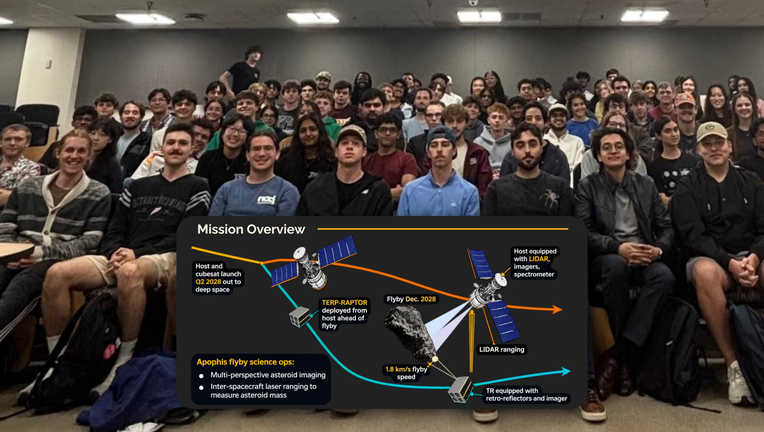
Maryland college students partner with NASA for 2029 Apophis mission (Credit: University of Maryland/TERP RAPTOR)
MARYLAND - A team of college students in Prince George's County is preparing to send a student-built spacecraft into deep space to study a massive asteroid before it passes closer to Earth than our own satellites.
Through a project called TERP RAPTOR, more than 90 University of Maryland students are designing, building and operating a small satellite, known as a CubeSat, to intercept the asteroid Apophis in late 2028.
The backstory:
In April 2029, Apophis—classified as a Potentially Hazardous Asteroid—will make the closest Earth flyby of an object its size in recorded history, passing close enough to be visible to the naked eye. While NASA and the European Space Agency are preparing missions to study the encounter, TERP RAPTOR is the only spacecraft being built entirely by students.
The project began in 2024 as an ambitious graduate capstone class in the A. James Clark School of Engineering and has since expanded into a 16-subteam operation made up of freshmen through PhD candidates.
According to mission documents, TERP RAPTOR is scheduled to launch aboard a commercial rideshare spacecraft in the second quarter of 2028. It will deploy ahead of a December 2028 flyby—roughly three and a half months before Apophis' closest approach to Earth—to complete three main goals:
Capture the first-ever up-close, multi-perspective images of Apophis.
Attempt the first LiDAR-based mass measurement of a potentially hazardous asteroid using laser ranging between the CubeSat and its commercial host spacecraft.
Generate a 3D model of the asteroid to share with the broader scientific community.
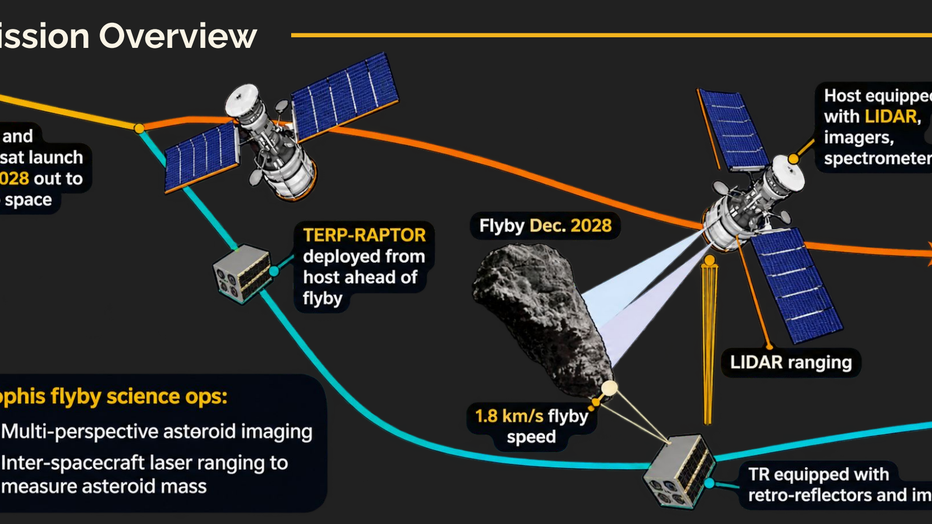
2029 Apophis mission overview graphic (Credit: University of Maryland/TERP RAPTOR)
NASA Goddard and DMV partnerships
The student team has signed a Space Act Agreement with NASA's Goddard Space Flight Center in Greenbelt, becoming the first students ever badged under the agreement to work out of dedicated lab space on-site.
The project has secured $380,000 in NASA funding alongside $46,000 raised through university crowdfunding. The team has also partnered with George Mason University—whose students are assisting with propulsion unit testing and engineering labor—as well as The Aerospace Corporation for environmental testing and technical support.
What's next:
The team is spending 2026 and 2027 finalizing spacecraft designs and procuring hardware before moving into assembly and testing ahead of the planned 2028 launch.
Beyond the Apophis mission, program leaders said their long-term goal is to establish a permanent CubeSat program and Space Mission Development Center in College Park so future cohorts of Maryland students graduate with real spaceflight hardware experience.
The Source: This article was written using information from the University of Maryland's TERP RAPTOR team.