

Cicada COVID Variant BA 3.2: What we know from the CDC
WASHINGTON - As the COVID-19 virus continues to evolve, here’s what to know about SARS-CoV-2 Variant BA.3.2, the "Cicada" variant.
What we know:
The highly divergent SARS‑CoV‑2 variant BA.3.2, informally nicknamed the "Cicada" variant, was first detected in a respiratory sample collected on November 22, 2024, in South Africa, according to the Centers for Disease Control and Prevention.
CDC scientists track emerging variants through international digital public health surveillance and U.S. genomic monitoring, including wastewater testing and traveler‑based sampling. By February 11, 2026, BA.3.2 had been reported in at least 23 countries, with global detections increasing beginning in September 2025. The first U.S. detection occurred June 27, 2025 through the CDC’s Traveler-Based Genomic Surveillance program in a participant traveling to the United States from the Netherlands.
RELATED: New COVID-19 variant spreading through multiple states: What to know
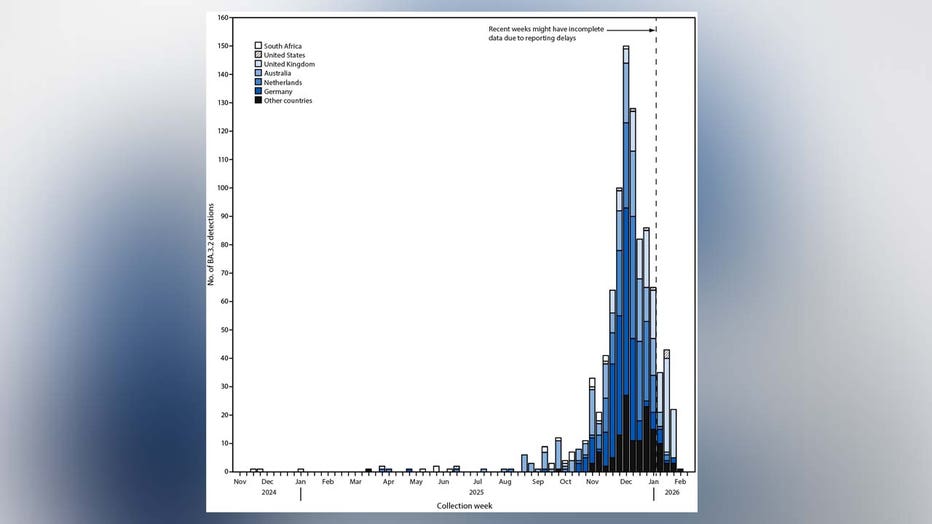
Cicada COVID Variant BA 3.2 (CDC)
Dig deeper:
As of February 11, 2026, the variant had been identified in nasal swabs from four international travelers, three airplane wastewater samples, five clinical patient samples, and 132 wastewater samples across 25 states. Wastewater surveillance often picked up the variant weeks before clinical testing, serving as an early warning system.
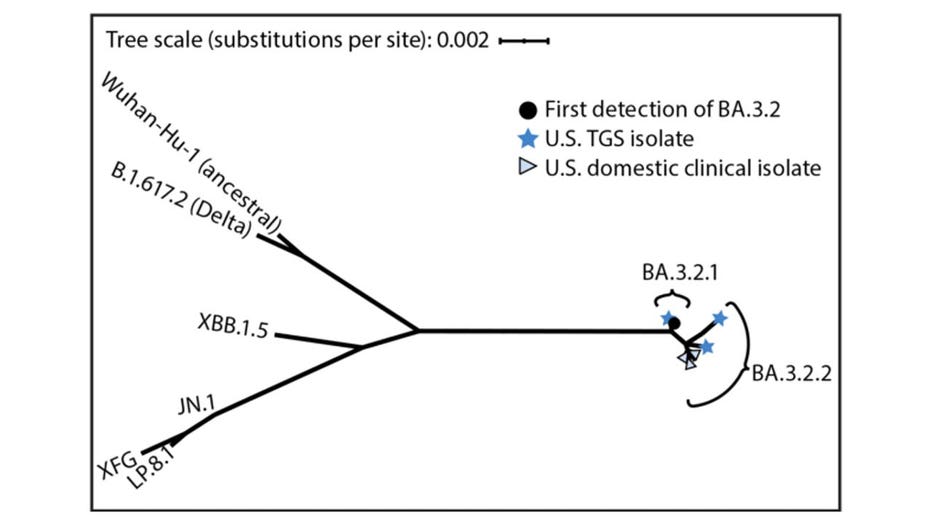
BA.3.2 is considered highly divergent, carrying 70–75 mutations in the spike protein. Those mutations suggest strong immune‑escape potential, meaning the virus may be altered enough that antibodies from prior infection or vaccination do not recognize it as effectively.
Current 2025–26 vaccines continue to protect against the predominant circulating variants, but laboratory studies show BA.3.2 has the lowest antibody neutralization among the variants tested. That does not mean vaccines stop working but that the protection against infection may be reduced.
Get more information from the Centers for Disease Control and Prevention online.
The Source: Information in this article comes from the Centers for Disease Control and Prevention.