

Red card rules at the FIFA World Cup: What can get a player sent off?
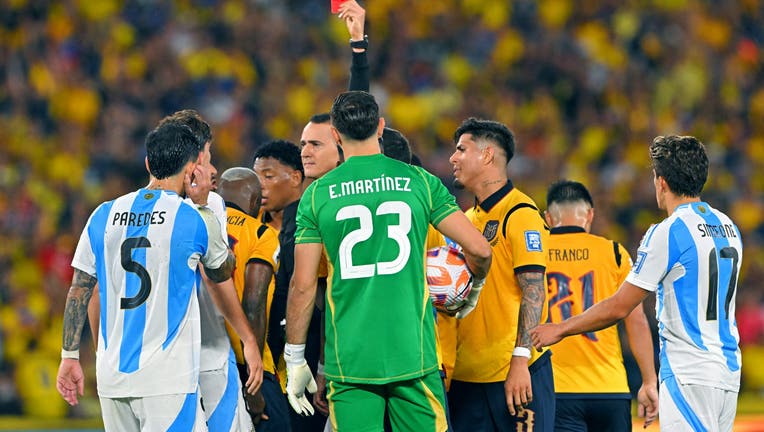
Colombian referee Wilmar Roldan shows a red card to Argentina's defender #19 Nicolas Otamendi (unseen) during the 2026 FIFA World Cup South American qualifiers football match between Ecuador and Argentina at the Monumental Banco Pichincha Stadium in
WASHINGTON, D.C. - The 2026 FIFA World Cup could bring new ways for players to see red, including rules aimed at mouth-covering confrontations and protest walkouts.
What we know:
A red card means a player is sent off immediately and cannot be replaced, leaving that team to play with one fewer player.
Players who receive a red card are also automatically suspended for the next match. FIFA’s disciplinary committee can add more games or fines depending on the seriousness of the incident, according to reporting by GOAL.
RELATED | Cover your mouth, risk a red card: FIFA targets hidden abuse at 2026 World Cup
Traditional red-card offenses include serious foul play, violent conduct, denying an obvious goal-scoring opportunity, offensive or abusive language and receiving two yellow cards in the same match.
World Cup rules generally follow the Laws of the Game, but tournament rules can differ from club competitions like the Premier League when it comes to discipline, suspensions and specific competition-approved rules. That means a player’s punishment at the World Cup may not always look exactly like what fans are used to seeing during the club season.
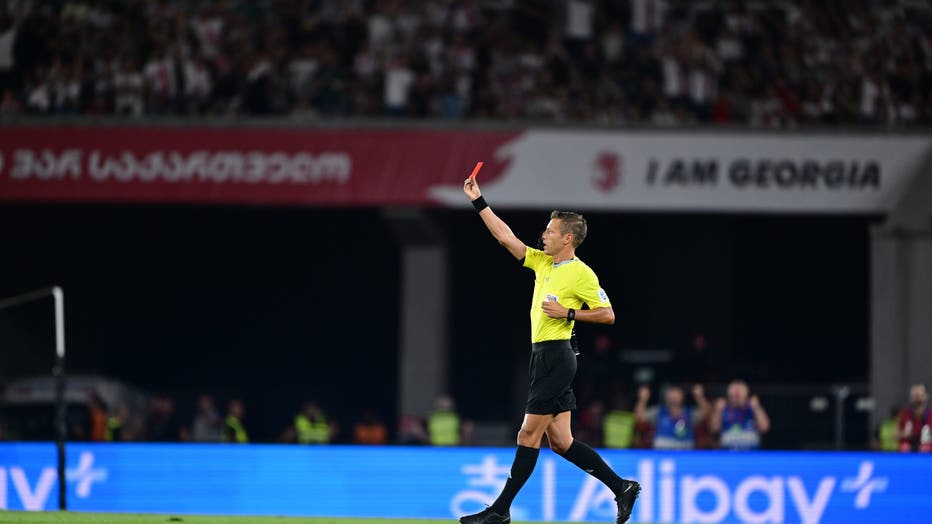
TBILISI, GEORGIA - SEPTEMBER 4: Referee Davide Massa shows a red card to Turkiye's Baris Alper Yilmaz during the 2026 FIFA World Cup UEFA Qualifiers Group E match between Georgia and Turkiye at Boris Paichadze National Stadium in Tbilisi, Georgia, on
New red card rules for the World Cup
The International Football Association Board approved two FIFA-proposed law amendments for the 2026 World Cup.
Players who cover their mouths to conceal discriminatory behavior in confrontational situations can be shown a red card, according to IFAB.
The rule comes after concerns over players hiding what they say during heated on-field exchanges.
IFAB also approved a red card for players who leave the field in protest of a referee’s decision. Team officials who encourage players to leave the field can also be sent off.
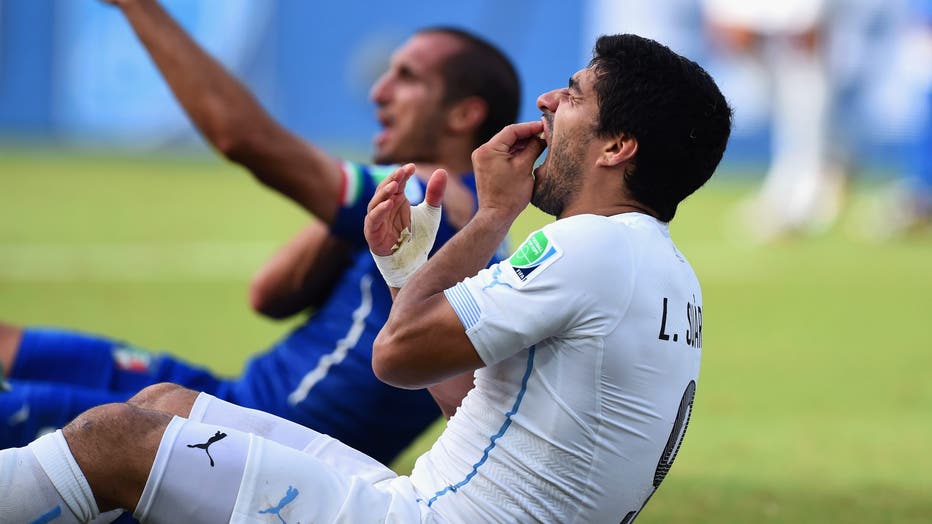
NATAL, BRAZIL - JUNE 24: Luis Suarez of Uruguay and Giorgio Chiellini of Italy react after a clash during the 2014 FIFA World Cup Brazil Group D match between Italy and Uruguay at Estadio das Dunas on June 24, 2014 in Natal, Brazil. (Photo by Matthia
What can get a player sent off?
Players can be shown a red card for:
- Serious foul play, including a dangerous tackle that endangers an opponent.
- Violent conduct, such as punching, kicking, head-butting, spitting or biting.
- Denying an obvious goal-scoring opportunity.
- Deliberate handball to stop a goal or clear scoring chance.
- Offensive, insulting or abusive language or gestures.
- Receiving a second yellow card in the same match.
- Covering the mouth to conceal discriminatory behavior during a confrontation.
- Leaving the field in protest of a referee’s decision.
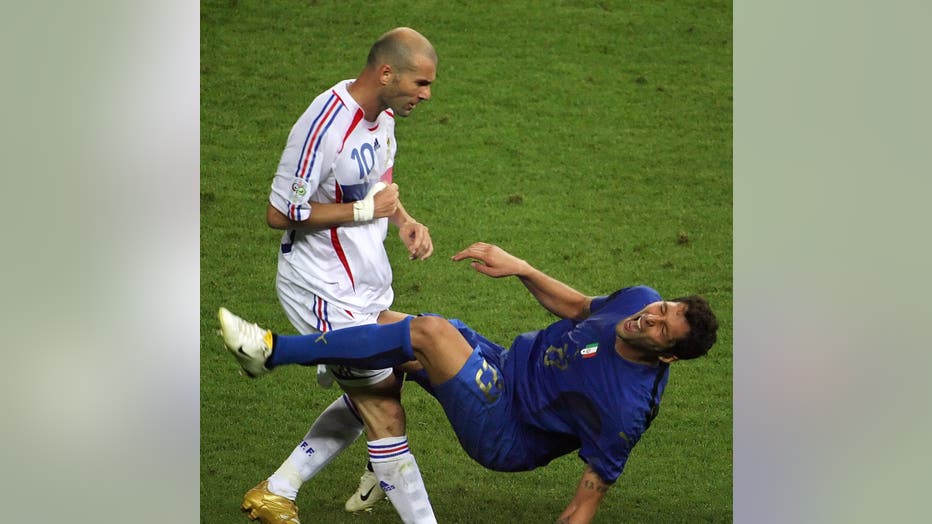
French midfielder Zinedine Zidane (L) gestures after head butting Italian defender Marco Materazzi during the World Cup 2006 final football match between Italy and France at Berlin’s Olympic Stadium, 09 July 2006. AFP PHOTO/JOHN MACDOUGALL (Photo cre
Why this matters
World Cup matches can swing on a single red card.
A sending-off does not just change the game in front of a player. It can also affect the next match, especially in a tournament where group-stage points, goal differential and knockout qualification can come down to small margins.
The new rules also show FIFA and IFAB trying to crack down on behavior that may be difficult for referees, cameras and fans to fully understand in real time, including hidden comments during confrontations and organized protests of referee decisions.
What's next:
The 2026 FIFA World Cup begins June 11, with matches across the United States, Mexico and Canada.
Players, coaches and officials are expected to receive guidance on the rule changes before the tournament begins.
READ: The Laws of The Game (PDF)
The Source: This article was written using information from GOAL, IFAB and USA TODAY.